

Agentic AI Starts in Back Office for a Reason

The most useful signal on agentic AI is no longer the demo. It is what happens after deployment. ETR Insights brought together technology leaders who are already operationalizing AI agents in IT and HR support and driving measurable gains in back-office workflows, with customer-facing use cases beginning to emerge.
What slows adoption is not curiosity. It is control. Governance, regulation, explainability, messy data, and hardware constraints are shaping how quickly agents can scale, and where they can safely operate. In the sections ahead, we break down the architectures and vendor strategies leaders are using to stay flexible, reduce lock-in risk, and decide when embedded AI features make sense, and when a more tailored, multi-model approach is worth the lift.
Key Takeaways
-
Agentic AI rolling out for back office uses first while governance concerns shake out. Agentic AI adoption is accelerating in back-office functions but remains constrained in customer-facing use cases due to concerns over governance, regulations, and reliability.
-
Flexibility is critical in keeping pace with AI technology. Panelists emphasize the need for flexible, modular AI architectures to avoid technical debt and quickly adapt to fast-evolving foundational models.

-
Data platforms bifurcating as enterprises separate BI from AI/ML. Snowflake remains the lead warehouse for data analytics, but Databricks’ perception as favored for data science, MLOps, and AI development remains.
-
Multi-tool environments preferred for AI development. Panelists are moving toward multi-model, multi-vendor ecosystems, leveraging multiple cloud platforms like AWS and Microsoft, and varying foundational models like OpenAI, Anthropic, and Mistral to balance compliance, performance, and cost.
-
Embedded AI features are taking hold. Panelists state that Salesforce, Workday, ServiceNow, and Freshworks are out in front with agentic and conversational capabilities tied to system-of-record data, while analytics incumbents such as Tableau and SAS are viewed as lagging.
-
Security and observability vendors are well-positioned for agentic automation. CrowdStrike, SentinelOne, Palo Alto Networks, and Dynatrace were mentioned by panelists as gaining AI-driven momentum.
Agentic AI Use Cases and Governance Challenges
Agentic AI is shifting from pilot to practical use across industries, though adoption remains uneven, as our panelists navigate questions around governance, regulation, and ROI. “We have implemented agentic AI in IT support and HR support help desk,” says one CIO of a large global financial services organization, “and we are looking at the implementation of agentic AI within customer sales and customer service. Adoption, I believe, is progressing from task-specific agent deployments towards more collaborative and autonomous systems.” Their colleague, from a healthcare-related enterprise, described his firm’s efforts as “RPA on steroids,” rapid back office gains in claims processing, though slower progress on customer-facing voice automation. They do point out, “A lot of other back office things are coming with these agents kind of built into their platform. As we move to our new HRIS platform next year, it comes with these inherently in those systems.”
One financial executive remains cautious regarding governance and frameworks. “We are heavily conscious around how can we expose this one from a customer perspective, because the concerns around hallucination, the concerns around run access control that you can go and have, exist and will continue existing.” With systems in place that work, they are wary of deploying agents that merely act as “a faster RPA or workflow automation type of capability.” A Director of IT for a global logistics company also spoke about the regulatory hurdles constraining automation. “For example, if you are doing something in the US, the final submit button has to be by a human on the US side. Even if it’s as simple as just automating this, we can’t do this.” Progress here will depend largely on the view of government agencies. “We are hopeful that with collaboration [with government], we will be able to move that needle further down this thing. But mostly in the digital and internal space, not so much on the external space yet.”
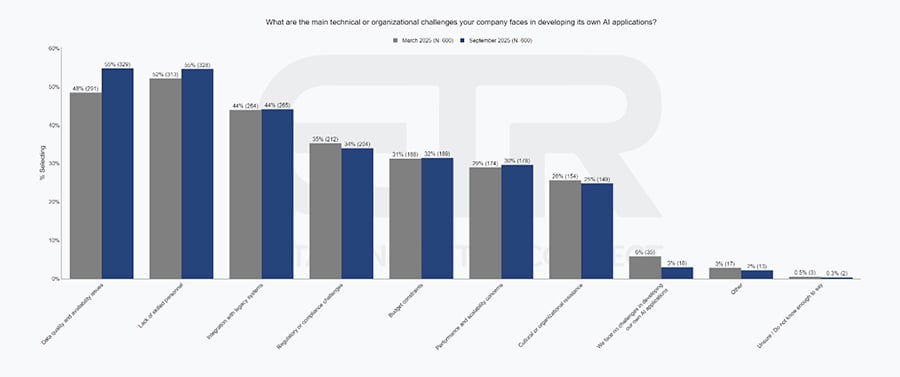
For one CIO, the challenge begins with structure, or rather, the lack thereof. Joining an organization strewn with unstructured data silos, they said the immediate task is preparing the foundation. “For us, this is going to be about data availability. My IT strategic plan for the year is data with AI as the copilot, getting that data first, and then working towards some of these AI initiatives.” In logistics, decades of growth through acquisition have left data fragmented and uneven. “There are data privacy and data localization issues. You have EU GDPR, China, Russia, India, and Brazil. You have siloed data localization that you have to do from the sovereignty perspective. It limits your ability to scale in the global world, the data governance issue.” With multinationals sitting on legacy infrastructure, questions also arise about where and how to run these systems, as hardware procurement alone has become an arms race. “For GPUs like the NVIDIA H100, you have to get into a line, and at the time that you are queued to get those ones, they came out with the new generation, the H200. You are getting behind all the time. If you are doing an investment like this, it’s an investment for five years. You don’t want to do an investment that in six months gets old.”
AI Architecture Should be Flexible, Not Brittle
In finance services in particular, the opacity of agentic systems undermines trust. However, explainability and auditability are not optional when automated systems influence underwriting or claims decisions. This panelist described agentic AI as “brittle,” with potential for hidden logic flaws and hallucinations. “Obviously, there is a risk of errors and bias.” Security, as always, is paramount, and our guest also worries that a shift toward independent AI agents could introduce new vulnerabilities.
Panelists urge companies to resist waiting for the “next big model” and instead adopt flexible architectures that can evolve with the technology. Foundational models are rapidly advancing toward more capable reasoning, but delaying investment could be more costly than committing to modular, adaptable solutions today. “You need to keep it light, and you need to keep it flexible so that you can quickly adapt the innovations, which kind of come along and which you find suitable for your organization. It’s similar, like in the past we integrated systems very tightly, but now we use APIs. We don’t depend on those tight integrations should we need to move on to a new solution.” In logistics, “The cost of indecision started to kind of lock us down from moving faster. We had to operationalize some of those models very quickly just to stay afloat.” Similarly, it is important to select vendor partners whose platforms can absorb rapid advances without saddling enterprises with technical debt. Keep in mind the growing complexity of orchestration, identity management, and security as agentic systems mature. “We ‘buy versus build’ just because we’re healthcare, and so having that transparency by your AI partner to know what the back-end technology is, so you do have that flexibility.”
Enterprises are accelerating toward multi-model and multi-vendor AI architectures as they seek flexibility, regulatory resilience, and specialized capabilities. Our panelists report heavy reliance on cloud platforms from Microsoft and AWS but said the real differentiation among foundational language models lies in their adaptability and domain relevance. “Our main approach is more, let’s go through the open-source models and integrate those as a more multi-model type of approach,” says one Senior Director in finance, “so that we can swap them easily if we need to.” This company relies on Microsoft and AWS platforms for scale, but wants to swap models as needed to drive performance and cost efficiency. “We are using Microsoft Azure OpenAI, and we are using Bedrock, for those big providers, for example, to give us the platform. But at the end, consumption of the model is more favored by getting the model that is serving for that specific purpose—it doesn’t matter if this is open-source or not—and start going from there.”
Diverse Tool Sets and Embedded AI Features
Some panelists have focused on hyperscalers, while others have split between data analytics tools, such as Snowflake, and data science tools like Databricks. “This multi-vendor strategy helps us optimize for data privacy, compliance, domain specialization, and deployment flexibility,” says one CIO, adding that their colleagues are pursuing similar diversification. On data warehousing, “Snowflake is really more for traditional analytics and business intelligence. It’s not close to what Databricks can provide from a data science compatibility, MLOps, and visibility standpoint.” One panelist is weighing Databricks and Google BigQuery as alternatives to Microsoft’s stack, particularly for conversational analytics. In human resources, “I think all the HRISs now are coming out with their own AI agents that kind of become that source of truth for everything for that employee record.” Overall, executives are signaling that they are ready to move beyond single-vendor commitments, as model diversity and data readiness become priorities.
Among this cohort, Salesforce and Workday are gaining, particularly as AI features move from experimental to embedded. “It especially helped that when Salesforce moved from price-per-interaction to a more reasonable usage-based, token-based pricing.” ServiceNow remains strategically important but is tempered by budget concerns. Even so, “Given that in the insurance industry we don’t always have enough in-house resources, [we’ll continue to] use or buy agentic AI technologies from the vendors.” AI in observability is a “natural use case for auto-repair, for detection of, and preventative treatment” of any emerging incidents; here, Dynatrace has moved to AIOps already.
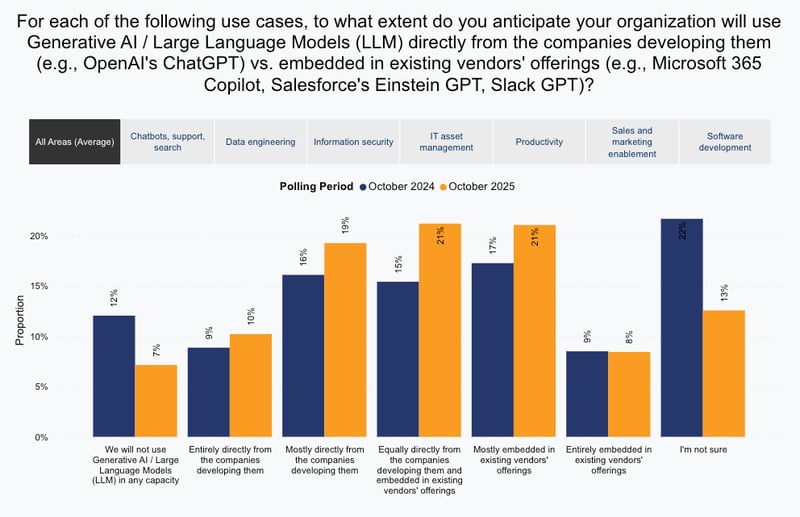
“We have another interesting twist that we are using,” says one Senior Director of IT Architecture, “Freshworks and Freddy AI for some of the AITSM [artificial intelligence for IT service management] side as well. That’s another one that they have been doing really impressed in evolution more from the traditional chatbot and the auto-resolution perspective, and ticket closure or call deflection perspective, when you’re talking about IT, the help desk side.” Charlotte from CrowdStrike and Singularity from SentinelOne are reshaping Level 1 and Level 2 incident handling and expanding their use of AI to reduce repetitive analyst tasks.
To one panelist, a surprising laggard is Tableau. “They are lagging in the way they are doing predictive analytics. From that perspective, I will say Parameter Analytics, for example, is doing better in that perspective.”