

AI Has Moved From the Feature Sheet to the Org Chart

Enterprise AI adoption is still led by productivity wins, but the Winter 2026 Macro Views data shows a more consequential shift. AI is moving from "help my teams work faster" to "help my business plan differently"—with large enterprises explicitly using AI to constrain future headcount growth. That distinction matters, because it signals where AI is headed next: into margin strategy, operating models, and long-term cost structure.
The Winter 2026 Signal That Matters Most
ETR's Winter 2026 Macro Views Survey captured feedback from 1,746 technology leaders, including 285 Fortune 500 and 421 Global 2000 respondents. This article covers only a portion of what the data reveals. (Download the Macro Views Survey Findings Summary for an expanded look at the full dataset.) Here is what stands out from the AI findings: productivity still leads the list, but that is no longer the headline. AI is now showing up in workforce strategy—and by extension, in margin discussions, operating model reviews, and boardroom cost conversations.
Productivity Remains the Entry Point
For most enterprises, the first business case for AI still looks familiar: automation, task augmentation, and removing friction from day-to-day work.
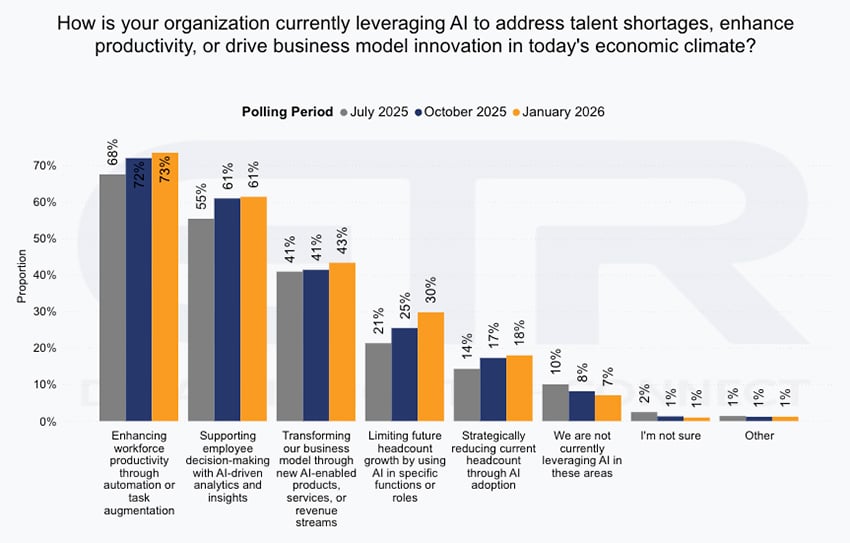
Seventy-three percent of respondents cite enhancing workforce productivity through automation or task augmentation as a primary AI use case. Sixty-one percent cite supporting employee decision-making with AI-driven analytics and insights, holding steady survey over survey.
This is the "safe" adoption path because it maps directly to existing KPIs—cycle time, ticket resolution, sales efficiency, time-to-decision. It is also how many organizations build internal confidence in AI governance, data readiness, and risk controls before scaling further.
But productivity is not the story anymore. It is the on-ramp.
Headcount Impact Moves Into the Mainstream
The more strategic change is how quickly AI is being connected to hiring and organizational design.
Thirty percent of respondents now report using AI to limit future headcount growth by deploying it in specific functions or roles, up sharply from 21% in July 2025. That rises to 34% among Global 2000 and Fortune 500 respondents, and climbs to 42% among Fortune 100 organizations.
This is a meaningful escalation because it reflects intent, not experimentation. Leaders are effectively saying: we expect AI to change how many people we will need to run this function.
It is also a more politically and operationally palatable posture than direct reductions. The survey data reinforces that distinction. Strategic headcount reduction through AI adoption is growing more slowly, reaching 18%, up from 14% last July. Many enterprises are choosing the quieter lever first—slow the growth curve rather than cut existing headcount. That is still a workforce strategy. It just looks like planning instead of layoffs.
The connection to broader spending behavior further reinforces the trend. Among the 15% of respondents planning to decrease IT spending in 2026, reducing staffing costs remains the single most cited lever at 25%. The same cost pressure driving IT budget cuts is also driving AI adoption as a workforce substitute.
Why the Largest Organizations Are Moving First
The Fortune 100 and Global 2000 have three structural advantages that make workforce-impact AI more feasible at scale. First, the sheer volume of repeatable work means more standardized processes and more opportunities to automate or augment reliably. Second, larger systems generate more data—structured and unstructured—to train, tune, and govern AI workflows. Third, when labor is a dominant cost input, even incremental productivity gains compound into material operating leverage.
This is where AI stops being a tool category and becomes a financial narrative.
Build vs. Buy Remains Balanced—Adoption Favors Vendors
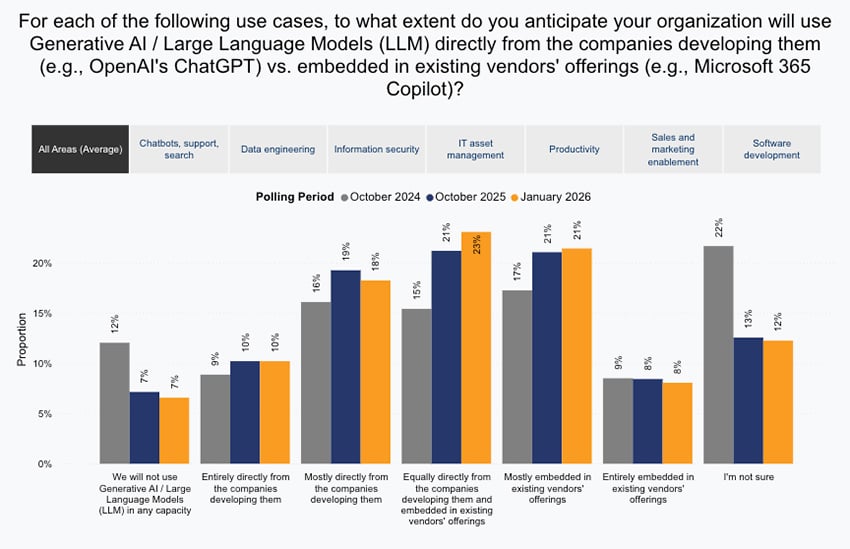
The "build vs. buy" question is still open across enterprises, and the Winter 2026 data reflects a pragmatic split. Twenty-eight percent of respondents rely primarily on models sourced directly from AI developers, 29% rely primarily on AI embedded in existing vendor offerings, and 23% report using both approaches equally—a figure that has grown sequentially and annually.
That balance makes sense. Core differentiation use cases tend to pull organizations toward building, while common workflows and horizontal capabilities often lean toward embedded vendor AI.
What is more telling is where adoption is actually scaling. Vendor AI solutions show higher adoption and active piloting at 71%, compared with 62% for in-house efforts. This aligns with what enterprise teams under pressure to deliver outcomes quickly are experiencing: vendor AI is easier to operationalize because it comes with productized workflows, security frameworks, and support models that fit existing procurement and deployment motions.
The Global 2000 Nuance on ROI
Even with adoption leaning toward vendors, the ROI picture is more nuanced. In-house building retains a nominal one-percentage-point edge overall—13% reporting sustained ROI at scale versus 12% for vendor solutions. But among Global 2000 organizations, ROI at scale from vendor solutions jumped to 17%, up from 11% in the prior survey.
The takeaway is not that build wins or buy wins. It is that scale changes the math. Large enterprises can realize strong returns from vendor solutions once they move beyond pilots into repeatable deployments, especially when AI is attached to high-volume workflows.
Takeaways
The data from the Winter 2026 Macro Views Survey points to a clear trajectory: AI is no longer just a technology discussion—it is a labor and margin discussion. Technology leaders who are still framing AI primarily as a productivity tool risk missing the broader organizational calculus that their C-suite counterparts are already running.
For enterprise technology vendors, the implication is equally direct. The buyers evaluating AI solutions in 2026 are not only asking about features and integration timelines—they are asking about headcount offsets, operating leverage, and long-term cost models. The vendors who can speak that language, and back it up with data, will have a structural advantage in the market.
AI has entered the boardroom. The question now is whether your go-to-market strategy has followed it there.
There is more data behind this story. Visit etr.ai/macroviewssurvey to download the findings summary, access the full report, and read more from the Winter 2026 Macro Views Survey.