

AI Raises the Stakes: Inside the 2026 State of Security Panel

AI is changing the economics of cybersecurity in 2026. According to an ETR State of Security Feedback Panel, AI has lowered the cost of launching an enterprise-grade phishing attack to roughly $20, compressed response timelines from days to minutes, and forced security leaders to rethink vendor evaluation, infrastructure spending, and data governance.
The cost of attacking a large enterprise has collapsed. AI has made attacks cheaper, faster, and more convincing. At the same time, it has made defense more expensive, more complex, and more dependent on strong data governance.
That tension was the central theme of this panel, where senior security leaders described how AI is reshaping security priorities. Their message was direct: AI is not just another tool in the security stack. It is changing the table stakes for how enterprises defend data, evaluate vendors, manage infrastructure, and prepare their teams for what comes next.
Key Takeaways
-
AI-generated phishing campaigns cost attackers as little as $20, compressing enterprise response timelines to minutes.
-
83% of technology leaders are evaluating Security for Generative AI in 2026, up from 75% in 2025.
-
CISOs are applying a three-part test to vendor AI claims: measurable risk reduction, lower operational burden, and explainable decisions.
-
Only 35% of enterprises plan to expand their cybersecurity vendor stack in 2026, down from 51% in 2024.
-
Decades of unclassified data in SharePoint and OneDrive must be remediated before AI governance can work.
-
Cultural resistance, not technology, may be the biggest barrier to AI security over the next five years.
How Has AI Changed the Cost of Cyberattacks?
The most urgent shift is not that attackers have new goals; it's that AI has made sophisticated attacks easier to execute. A CIO and CISO explained that AI has reduced the cost of entry for attackers, putting tactics once associated with advanced nation-state groups within reach of almost anyone. "We used to worry about advanced nation-state attacks, and kind of put a bunch of thought in terms of how we measure risk and how we look at different attack vectors. But now, with a $20 subscription to certain AI infrastructure, code could be written to exploit phishing emails that are flawless, and very contextualized, and targeted to specific high-value targets within your company. It's an arms race at the end of the day."
That shift puts new pressure on one of the oldest problems in security: human behavior. The same panelist noted that even the best technology cannot fully remove the risk of a person clicking a malicious link, downloading the wrong file, or opening an unintended back door.
The threat is not theoretical for enterprise security teams. A Chief Security Architect said compromised third-party partners are increasingly being used as jump points into the enterprise, and AI-generated deepfakes are accelerating the volume of attacks. "The bad actors are leveraging AI to create these new threats, so we are also changing our posture, trying to leverage similar AI capabilities to thwart those attacks... we have to respond now, not in a matter of days or weeks or even hours, it's got to be minutes now. We are trying to fight the AI with AI." Security teams are no longer defending against attacks that unfold over long timelines. They are preparing for minutes.
Which Security Categories Are Enterprises Prioritizing in 2026?
ETR runs its Annual State of Security survey each year to measure how tech leaders are prioritizing cybersecurity spending, evaluating vendors, and responding to emerging risks. The 2026 edition drew responses from over 500 senior technology, security, and infrastructure decision makers from the ETR Community. Among the respondents, 83% have evaluated or plan to evaluate Security for Generative AI in 2026, up from 75% in 2025. LLM Security rose to 76%, Data Security increased to 72%, and Non-Human Identity Management reached 70%.
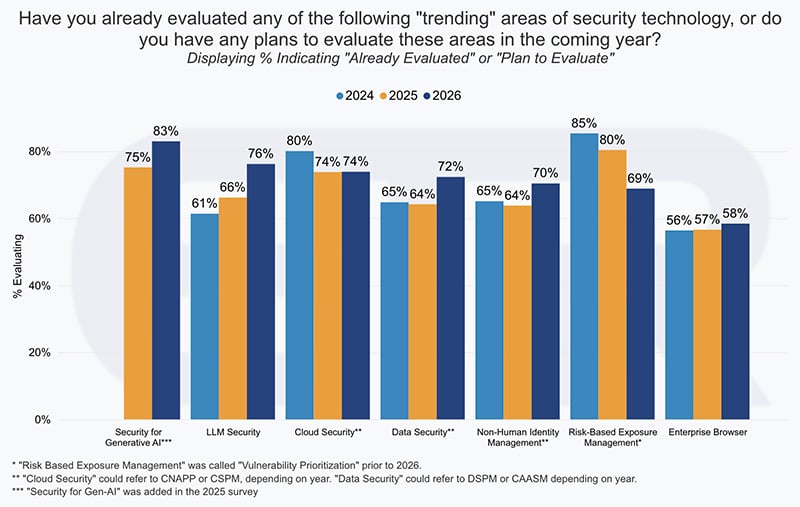
Figure 1. Percentage of technology leaders who have evaluated or plan to evaluate each security technology category, 2024 to 2026. Source: ETR 2026 Annual State of Security survey, N=517 senior IT and security leaders.
Those increases show where enterprise attention is moving. AI is not only creating new attack vectors. It is also pushing security leaders to rethink identity, access, data controls, governance, and the relationship between human and machine activity.
The data also suggests the market is becoming more selective. Risk-Based Exposure Management fell for the second consecutive year, and Enterprise Browser remained mostly flat. In other words, not every trending category is gaining equally. Security leaders are prioritizing the areas where AI creates immediate operational and governance pressure.
How Are CISOs Evaluating Vendor AI Claims?
The panelists were clear that they do not take vendor AI claims at face value. One CISO described a three-part test applied to any product claiming AI capability. First, does the feature reduce risk in a measurable way? Second, does it reduce operational burden instead of creating more work? Third, can the vendor explain how the AI is making decisions? "Number one, are we measurably reducing risk with this new introduced feature set? Number two is the operational burden on my team... if a tool is coming forward and claiming certain aspects of AI going to automate, make decisions, and do certain things, I want to make sure that we're not going to have to undo all of that work, or then clean up the mess. And then number three is, is it really AI? Can the company or the tool actually explain how it's making decisions? I'm the one that's ultimately going to be accountable as the CISO."
The standard matters for technology vendors. Security leaders are not simply looking for AI labels. They are looking for proof. If a capability cannot reduce risk, improve operations, or explain its logic, it may not earn trust no matter how attractive the messaging sounds.
Are Enterprises Consolidating Their Security Stacks?
Platform consolidation is gaining ground, and the panelists were cautious about moving too far in one direction. Some leaders are rethinking best-of-breed strategies because managing too many tools creates operational drag. One IT leader said a portfolio with 20 to 30 tools can turn the year into a cycle of contract negotiations, procurement discussions, and integration work.
ETR's data supports the shift. The proportion of technology leaders planning to expand their cybersecurity vendor stack has dropped meaningfully over the past two years, while the share planning to hold steady has grown.
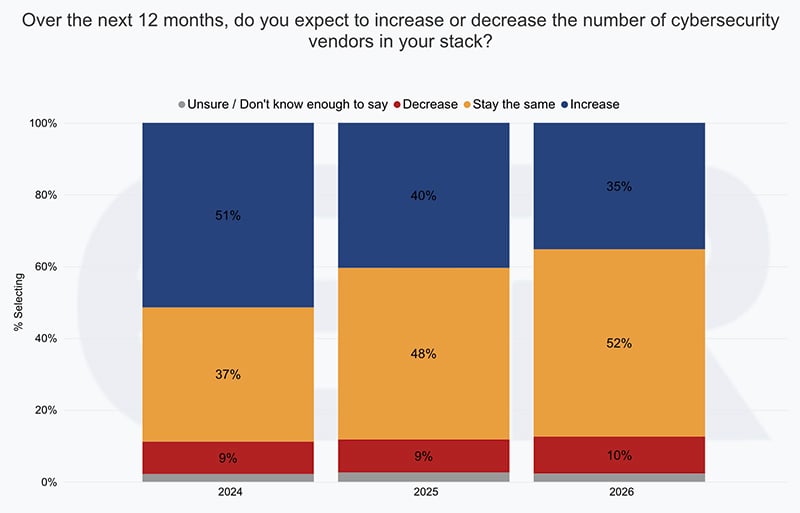
Figure 2. Expectations for cybersecurity vendor count over the next 12 months, 2024 to 2026. Source: ETR Annual State of Security surveys, 2024 to 2026.
That does not mean enterprises are ready to hand the entire security stack to one vendor. Panelists still worry about single points of failure. Instead, many appear to be moving toward a more practical middle ground: fewer strategic partners, stronger integrations, and more proof that bundled capabilities actually work. As one Chief Security Architect put it, "They are trying to become a one-stop shop. Now we are having to kind of like revisit our philosophy saying like, okay, we were doing best-of-breed, [but] does the best of suite make sense for us?"
The answer is not yet settled. But the evaluation criteria are changing. Roadmap depth, proven efficacy, acquisition strategy, and vendor accountability now matter as much as feature comparisons.
Why Is Data Classification a Prerequisite for AI Security?
One of the most important points from the panel was also one of the most basic: AI security depends on knowing what data exists and who should have access to it. For many enterprises, that foundation is weak. Years of unclassified documents in file shares, SharePoint, and OneDrive have created a serious exposure surface. When AI tools are pointed at those environments, they may surface information users were never meant to see.
One panelist explained the problem clearly: "People have been just creating these documents, and all kinds of artifacts, and they've just been throwing it there. It's just going to go after anything and everything that it can find, and spit out data one probably should not be even privy to, like HR data, financials, and so on."
Retroactive classification at enterprise scale must precede meaningful AI governance, and there is no shortcut. Another panelist summarized the issue with a line that should sit on every AI security roadmap: "Without being able to classify your data, you don't even know how to enforce your controls." AI may be new, but this challenge is not. The difference is that AI makes old data hygiene problems visible, searchable, and potentially dangerous at scale.
Why Is Agentic AI Outpacing Security Governance?
Video. ETR Insights panel discussion on agentic AI governance. Senior security leaders from education, retail, and consumer enterprises discuss the governance gap behind agentic AI deployment, the rush to proof-of-value over security rigor, and the case for treating AI agents with the same identity, privilege, and risk controls applied to human staff. Source: ETR Insights Interview 468, March 2026.
Agentic AI adds another layer of complexity. These systems do not just retrieve information. They manipulate data, trigger workflows, and make decisions. That means they need identity governance, privileged access management, decision controls, and risk assessments at the same rigor applied to human staff.
One executive responded to internal enthusiasm by standing up a dedicated AI governance body, separate from standard security and risk assessments. "We instituted something like AI governance. That is separate from the standard security assessments, risk assessments that we do. This is AI governance, which has stakeholders, representatives from all the different parts of the enterprise... There is more guardrails that need to be in place, because we can't just let these AI agents just run amuck and try to start accessing anything and everything." Their posture is deliberate: "From a crawl, walk, run approach, we are still crawling into the space."
ETR's data on agentic control preferences reflects the same uncertainty. There is no dominant operating model yet, with respondents split across four meaningfully different approaches.
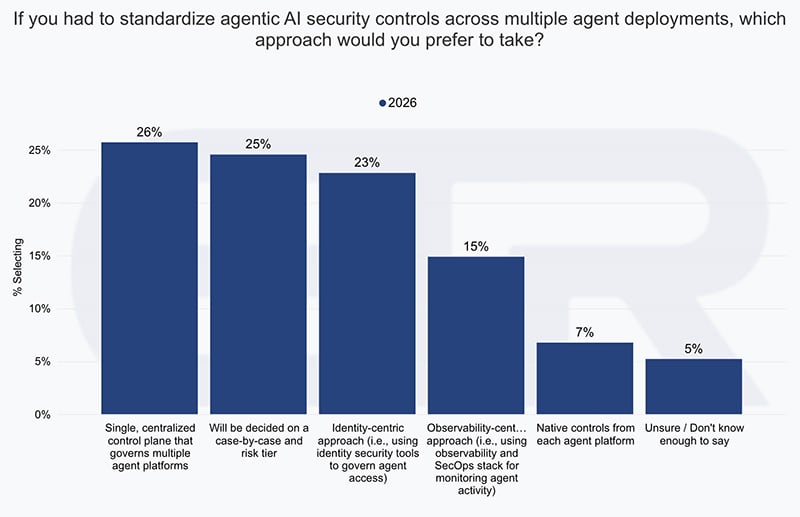 Figure 3. Preferred approach to standardizing agentic AI security controls across multiple agent deployments. Source: ETR 2026 Annual State of Security survey, N=517 senior IT and security leaders.
How Are AI Infrastructure Costs Affecting Security Budgets?
The AI security conversation is also a budget conversation. One executive reported infrastructure price increases of 100% to 300% on certain components, driven by AI data centers absorbing global supply. That pressure is forcing leaders to reconsider whether AI workloads should run on local infrastructure or move to the cloud. "Do we invest in the infrastructure where we can put this in-house, where we have the safeguards and the controls in place, and we can build local LLMs running off of local memory, local infrastructure? Or do we pay the subscription fees and push that out to the cloud with various risks around it?"
The economics may now favor cloud-based AI compute, depending on risk tolerance. That is a notable shift because local infrastructure offers control, but cloud increasingly offers more practical cost and scalability. Another panelist said legacy infrastructure refreshes are already consuming budget needed for AI initiatives, so their organization is trying to unlock AI capabilities from existing licensing and partnership agreements rather than fund entirely new projects. The signal for vendors is clear: solutions that fit into existing agreements, reduce cost elsewhere, or improve operational efficiency will have an edge.
How Does Microsoft Compare to Security Specialists in 2026?
Microsoft's expanding security portfolio also came up throughout the panel. Leaders said Microsoft is improving across identity, governance, email protection, data security, and endpoint, especially within its own ecosystem. But premium licensing costs and non-Windows environments leave room for competitors. One Chief Security Architect said, "From what we've seen from a data security perspective, they are doing very well as far as where their data stores are. But when it comes to other data storage vendors, there are opportunities to do better, which is where I think there are other vendors in this data security space that are outshining them."
Another panelist compared Microsoft's position against CrowdStrike, Proofpoint, Okta, and SailPoint, and concluded that Microsoft is narrowing gaps but specialists still matter. "Microsoft is kind of the monolith here. It's massive. It's like turning the Titanic. They have such a breadth of delivery and portfolio, for them to stay abreast and catch up with every single vendor that's out there." For buyers, this creates a familiar tradeoff: integration and licensing simplicity versus specialized depth. For vendors, it reinforces the need to prove why a dedicated solution remains necessary.
Why Is Culture the Biggest Barrier to AI Security?
Looking ahead, panelists converged on a striking conclusion: the biggest security failure ahead may not be technological. It may be cultural. The CIO and CISO put it bluntly: "I'm going to vote on cultural. I think the technology will be solved by the technology; the integrations, the governance, those aspects will all be solved... I think what's going to be hard, what AI can't solve for us, is the impact to the human-centric process that we are going to be facing."
The retail security architect agreed, describing a reflexive defensive reaction inside their own organization. "There is that apprehension, that constant apprehension when we are trying to actually pitch a new AI capability. The very first question that gets asked is, oh, is this trying to replace any of our analysts or anybody that we have in this space? That cultural shift is probably going to persist for some time."
This may be the hardest issue for leaders to solve because it is not a procurement problem or a feature gap. It is a trust problem.
What Should Security Leaders Do Next?
The ETR panel describes a cybersecurity market being reshaped from multiple directions at once. AI has lowered the cost of attack, increased the need for real-time response, exposed data classification debt, and forced new governance questions around autonomous agents. For security leaders, the path forward requires discipline:
-
Treat AI security as a data governance challenge, not just a tooling challenge.
-
Push vendors to prove risk reduction, explainability, and operational value.
-
Revisit consolidation strategies without creating single points of failure.
-
Build identity and privilege controls for non-human actors.
-
Address employee anxiety early so AI adoption does not stall culturally.
-
Look for AI value inside existing licensing agreements before adding net-new tools.
The security teams that move fastest will not be the ones that buy every AI-branded product. They will be the ones that understand where AI changes the risk model, where it improves defense, and where it simply exposes problems that were already there. AI has raised the stakes. Now security leaders have to raise the standard.
Access the Full ETR Research
The complete ETR Insights panel transcript and the full 2026 Annual State of Security survey results are available to ETR clients. Contact the ETR Service team to request the interview, explore the underlying data, or commission custom research on how senior IT and security leaders are evaluating AI security, vendor consolidation, and agentic governance in 2026.