

As Anthropic Hits the Road, Quality Is Still Winning the AI Budget

Claude extended its lead with enterprise buyers in November, and the demand behind that lead is starting to surface as friction around cost and capacity.
Claude leads enterprise AI tools on satisfaction, spending plans, and coding, according to ETR’s November 2026 AI Tools Pulse. Microsoft 365 Copilot still has the widest broad use, at 68% of companies, but Claude is gaining fastest: broad use rose from 38% in June to 62% in November. Six months into the series, enterprise buyers keep choosing quality over price. The November 2026 edition surveyed 200 technology leaders on how they use, rate, and pay for four of the most widely deployed AI tools in the enterprise: Anthropic Claude, Google Gemini, Microsoft 365 Copilot, and OpenAI ChatGPT.
The result is a market that is consolidating around a leader. Claude ranks first on adoption momentum, satisfaction, spending plans, and coding. The same demand that put it there is now creating pressure on pricing and capacity, and that pressure gives competitors an opening.
Key Takeaways
-
Claude’s footprint keeps widening. Broad use has climbed steadily since June, and a sizable pilot base points to further conversions ahead.
-
Satisfaction is translating into budget. Claude remains the highest-rated tool, and its buyers are the most likely to plan bigger spending over the next year.
-
Coding is the stronghold. Claude Code is the most widely deployed coding tool, holds the largest share of coding budgets, and retains nearly all of its users.
-
Demand is testing capacity. Claude users run into usage limits more often than users of any other tool, and buyers are responding in different ways.
Which AI Tools Are Enterprises Using Most?
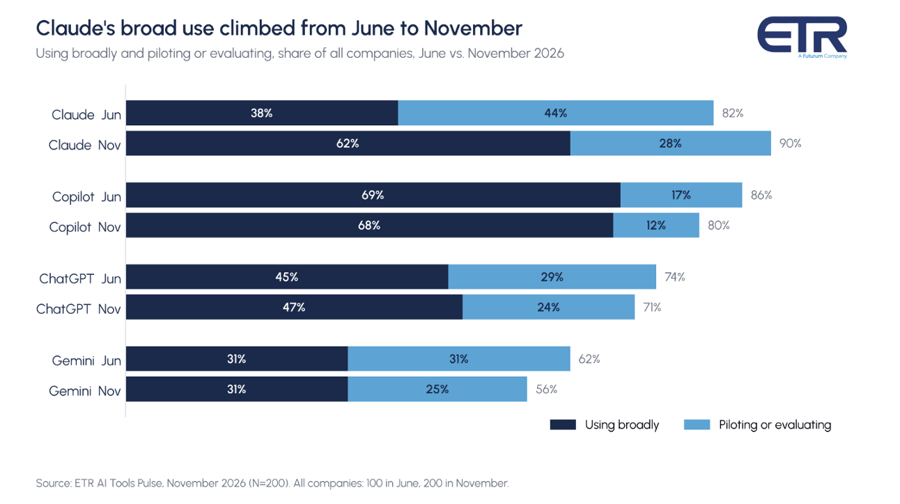 Broad use of Claude now reaches 62% of companies, a steep climb from where it stood when the Pulse launched in June. A meaningful group of organizations is still piloting the tool, which leaves a clear path to further expansion. Copilot, by contrast, sits closer to saturation, with a much smaller pilot pool.
Consumption growth has settled into a plateau, though at a high level. Most Claude users continue to grow their usage month over month, and roughly one in five grew it by more than 25% in November. “Our employees love Claude,” wrote a respondent at a North American Fortune 100 IT/TelCo company.
Satisfaction Drives Spending Plans

That loyalty carries directly into budgets. Among Claude buyers, 81% expect to spend more over the next 12 months, the highest of any tool tracked.
How customers pay adds to the picture. Claude buyers lean more heavily on API and token-based consumption than buyers of peer tools, which rely more on seat subscriptions. Usage-based revenue scales with workloads.
Coding Is the Crown Jewel
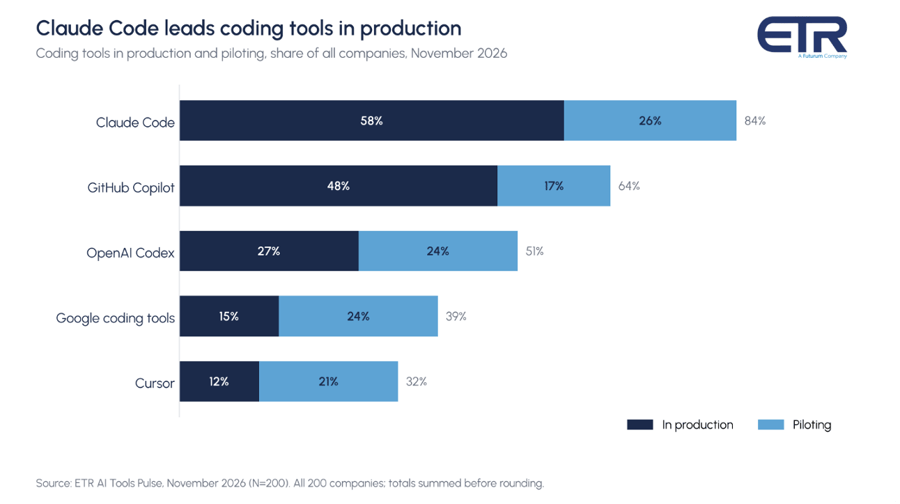 Claude Code is in production at 58% of companies, ahead of GitHub Copilot, with another sizable group piloting it. It also captures the largest share of coding-tool spending, and its churn runs well below GitHub Copilot, Cursor, and Codex. OpenAI’s Codex trails on production use but is drawing a pilot base that rivals Claude Code’s, making it the competitor to follow in this category.
How Are Enterprises Handling AI Costs and Usage Limits?
Popularity brings pressure. Pricing ranked among the more frequent themes in respondent commentary, and more Claude buyers reported rising effective token prices than buyers of any other tool. “The cost of the [latest] models from Anthropic continue to be at a premium cost,” wrote a respondent at a large North American Services/Consulting firm.
Usage limits are the other pressure point. Claude users hit them more often than users of any peer tool. Companies handle those limits in a range of ways: some wait for the reset, some buy extra credits, some upgrade their plans, and some shift work to another provider. Formal spending caps remain the exception. “The cracks are beginning to show from a supply/demand POV,” noted a respondent at a North American Fortune 500 Industrials company.
Workloads remain sticky. About a third of companies moved AI work between providers over the past 30 days, and most of those moved a modest slice of their usage. Quality drove 43% of those decisions, well ahead of price. Anthropic was the largest net beneficiary of those moves, and OpenAI was the other net gainer. Written comments about OpenAI’s newest models skewed favorable. Open-weight models, while widely used, were a net source of migrated work. “Looking into Terra from OpenAI and looking more into open weights as these become more and more expensive,” wrote a respondent at a large North American IT/TelCo firm.
The Lead Comes With a Price Tag
Quality still sets the order in enterprise AI, and Claude sits at the top of it. The question ahead is whether cost and capacity constraints begin to erode that position. For buyers, routing workloads across multiple providers is becoming standard practice. For vendors and investors, the signals worth following are how customers pay, how often they hit limits, and where workloads move next.
Get the November AI Tools Pulse
The full November 2026 AI Tools Pulse includes spend levels, consumption drivers, verbatim write-ins, and scorecards for all four tools. Reach out to the ETR sales team at sales@etr.ai to discuss the complete findings ahead of Anthropic’s listing next week.
Data sourced from ETR’s AI Tools Pulse, November 2026. N=200. Survey conducted November 2026.