

Enterprises Bet Big on Agentic AI, Then Hit the Brakes

Enterprises pushed deeper into agentic AI over the summer, even as rising costs began deciding who gets access to frontier models.
This article draws on ETR's August 2026 AI Tools Pulse, a monthly report that asks technology leaders how they use, rate, and pay for four of the most widely deployed AI tools in the enterprise: Anthropic Claude, Google Gemini, Microsoft 365 Copilot, and OpenAI ChatGPT. That edition captured a market pulling in two directions at once. Organizations handed more work to AI agents than ever, while the cost of that work began reshaping access policies, model choices, and budgets.
Key Takeaways
-
Quality and cost pulled apart. Claude kept its lead on satisfaction, but pricing climbed into the second-most-cited theme in respondent commentary.
-
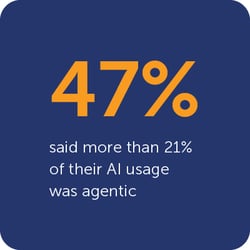
Agentic usage spread wider. Nearly half of organizations reported that more than a fifth of their AI usage was agentic, a clear step up from July.
-
Budget discipline trailed ambition. Few companies capped AI consumption in August, yet more than twice that share expected to within three months.
-
Open-weight models took share of the workload. Adoption was already widespread, and it chipped away at proprietary usage without replacing vendors outright.
 Quality Leadership Came With a Price Tag
Claude held the highest overall satisfaction score of the four tools in August and led the ratings across most of the use cases the Pulse tracks. That lead came with a growing caveat.
Perception of Claude slipped more than any peer's over the month, even as satisfaction rose. The commentary points to a likely reason. Cost went from one of the smallest write-in themes in June to one of the largest by August, and respondents were specific about how they were responding.
"Anthropic Fable 5 is so expensive that we have had to limit who has access to it," said one respondent at a midsize Services/Consulting organization. Another, at a small Financials/Insurance firm, put it more bluntly: Claude "keeps holding its lead in intelligence, but it comes at a massive premium."
The rest of the field told its own stories. Microsoft 365 Copilot remained the deployment leader by a wide margin and posted its best satisfaction reading of the three iterations tracked, though users continued to flag inconsistent UX and sign-in friction. ChatGPT gained ground on broad deployment, with one respondent observing that "OpenAI has come roaring back in terms of price and quality." Gemini kept the smallest footprint of the four but was the only tool to improve on every use case measured.
Agentic Adoption Grew Wider, Not Deeper
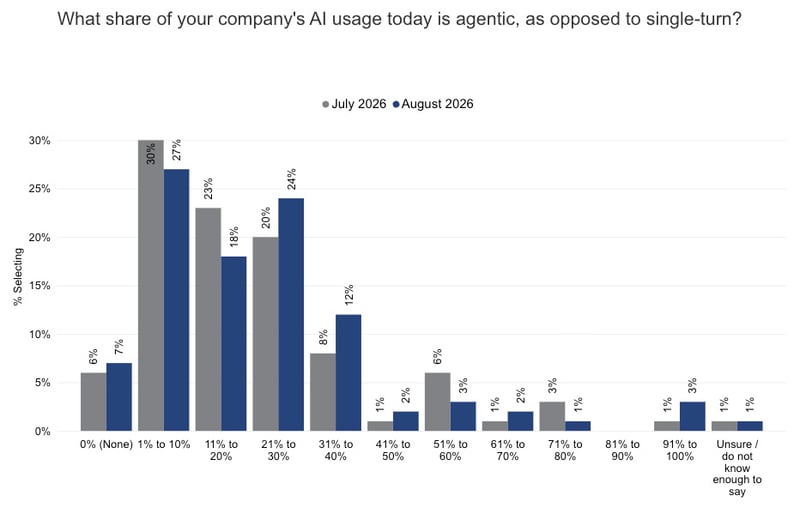
The clearest structural shift in August was agentic adoption. Forty-seven percent of organizations said more than 21% of their AI usage was agentic, up from 40% in July. Looking ahead, a strong majority expected their mix to lean further toward agentic use over the next quarter, while almost no one planned to move back toward single-turn interactions.
What drove that growth matters as much as the growth itself. Across every tool, respondents overwhelmingly named more tasks, rather than more tokens per task, as the biggest driver of rising consumption. The complexity of agentic workflows in production stayed broadly flat month over month, with most still described as moderate in scope.
In other words, enterprises were running agents in more places, not asking those agents to do dramatically harder things. As one Global 1000 respondent in Services/Consulting described it, "Agentic AI is moving from experimentation to operational use."
That breadth-first pattern has consequences: consumption scales with every new workflow, which puts cost back at the center of the story.
Ambition Met the Budget
August's data exposed a gap between where enterprises wanted to go and what they were prepared to pay for. Only 17% of respondents said their company managed AI consumption against hard limits or budgets, a figure that did not move from July. Yet a far larger share expected to be doing exactly that within three months.
The irony is in the levers. Among companies managing or planning to manage against hard limits, restricting agentic workloads tied for the top method of controlling consumption. The same organizations betting on agentic AI were preparing to ration it.
Respondents described the tension in practical terms. "Updated metered consumption and costs will affect how we connect and build," noted one respondent at a large IT/TelCo organization. Another at a large IT/TelCo firm called it "a constant battle between new models with higher token burn thus higher costs and using different models more suited to problem."
Other levers included renegotiating vendor pricing, consolidating tools, and shifting users onto cheaper models. How those choices distribute across vendors matters for anyone forecasting AI spend.
Open-Weight Models Became Part of the Mix
Open-weight models offered enterprises another path. Forty-six percent of respondents said their company was already using them, and adoption concentrated at organizations running the broadest AI stacks.
Roughly half of open-weight users said these models had reduced their usage of at least one proprietary tool. But with penetration of the major vendors holding up, the pattern pointed to open-weight models taking a share of the workload rather than displacing vendors entirely.
What August Signaled for the Months Ahead
The August Pulse described an enterprise AI market entering a more disciplined phase. Capability still won loyalty, and agentic use kept expanding, but the most committed organizations were also building controls aimed squarely at the workloads driving growth.
For investors and vendors alike, the question coming out of August was which tools would hold their share once budgets tightened, and which would settle into the "good enough" role.
Get the Latest AI Tools Pulse
The September 2026 AI Tools Pulse is now available (and October soon to come), with updated reads on satisfaction, consumption, agentic adoption, and cost controls across all four tools. To find out whether August's cost pressure eased or intensified, contact our service team for access to the most recent findings.