

How Cloud-Native Momentum Came to Define Data Warehousing

Before the new Observatory for Cloud Data Warehouses arrives, a look back at what senior technology leaders' thoughts during the 2025 feedback panel: Snowflake and Databricks led on innovation, Microsoft on consolidation, and hybrid looked like the realistic destination.
ETR's Observatory for Cloud Data Warehouses releases later this month. Before the fresh data lands, we are revisiting the feedback panel that accompanied last year's report, which surveyed 321 technology leaders and offered the series' first year-over-year comparisons. The conversation brought together three technology leaders from financial services, technology, and retail, and it offered a sobering baseline. Cloud-native platforms had the momentum, legacy vendors had the installed base, and the friction between the two was pushing some enterprises toward hybrid arrangements rather than a clean break. No single vendor, and no single deployment model, was going to solve enterprise data warehousing on its own.
Key Takeaways
-
Cloud-Native Vendors Set the Pace: Panelists named Snowflake, Databricks, and the three public cloud providers as the leaders in data warehousing, citing innovation and performance, while legacy names trailed on spending momentum.
-
On-Premises Refused to Disappear: Legacy platforms kept specific roles, and panelists described cloud repatriation underway at large organizations for cost, security, and scalability reasons. Hybrid, not cloud-only, looked like the realistic destination for some.
-
Messy Data Made a Case for AI: One panelist argued that raw, loosely structured data was proving more useful than clean, schema-bound warehouse data in early AI experiments, lending fresh relevance to data lake strategies and to platforms with object storage underneath.
-
ROI Stayed Elusive, and Cost Was Not the Tiebreaker: Executives admitted they could not pin down cloud warehouse returns, and one argued that long-deployed legacy systems had already paid for themselves many times over. Security, performance, and interoperability carried more weight than price.
Snowflake and Databricks Led, Google Surprised on the Downside
The 2025 ETR Observatory for Cloud Data Warehouses placed Snowflake, Databricks, Microsoft Azure Synapse, Amazon Redshift, and Google BigQuery at the front of the landscape. What caught the panel off guard was Google's relative weakness against Microsoft, a gap ETR attributed to presence rather than spending intentions. "It has a very heavy footprint in my company," said the Director of Data Science and Analytics at a large retail or consumer enterprise. "Snowflake and Databricks are more like new entrants for us."
Momentum, however, belonged to the cloud-native names. Snowflake jumped from third to first in Net Score year over year, with Databricks close behind, while Cloudera, OpenText, and IBM posted some of the steepest declines. Oracle was the one legacy vendor to post a modest uptick, though the Principal Storage Architect and Senior VP at a large financial institution was unmoved: "To me, that's the past, not the future. I don't see any development in their technology."
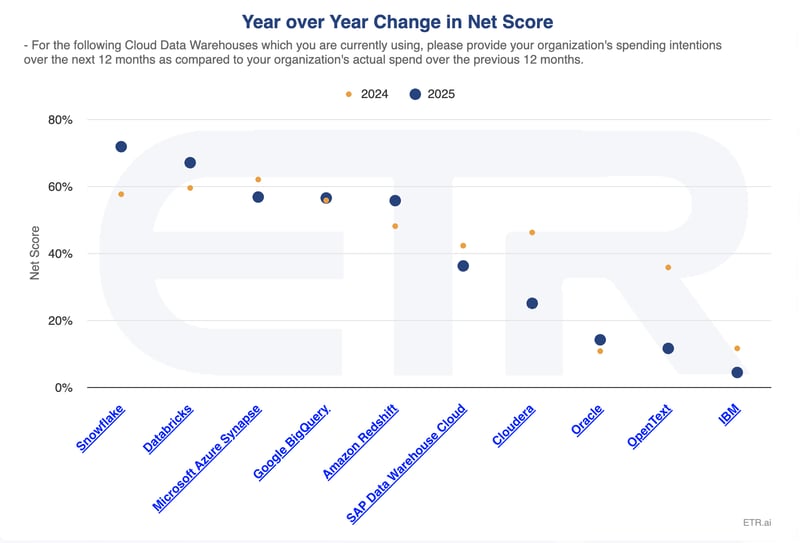 In the 2025 ETR Observatory for Cloud Data Warehouses, year-over-year changes in Net Score show growth in spending momentum for cloud-native vendors like Snowflake and Databricks, while Cloudera, OpenText, and IBM decline. Oracle breaks the mold, a legacy vendor seeing modest growth in spending intentions.
The Director of Cloud Infrastructure Strategy at a large technology enterprise noted that the growth was coming from expansion, not just new logos: "Some of this spending growth, at least the projections of spending more money, is not just driven by new customers, but also by existing customers."
Repatriation and the Hybrid Middle Ground
The storage architect pushed back hardest on the idea that the cloud was the only destination, arguing that for large financial institutions running their own private clouds, public cloud is "no cheaper, less controlled, less secure." He went further: "75% of Fortune 500s are experiencing reverse cloud moves. That's not a fantasy, that's just a hard fact." The cloud infrastructure director pointed to public discussion boards where "people are facing some challenges scalability-wise on these new tools," naming Snowflake and Databricks specifically, compared with legacy platforms like Teradata and Cloudera that had been proven at scale.
For the storage architect, the answer was hybrid, and he pointed to BigQuery's ability, under specialized agreements with Google, to run on Google hardware inside a customer's own data center. "This creates a very competitive hybrid, which from our point of view, will be the nearest future. We will step back from cloud-only to a hybrid situation for data warehouses." A separate ETR Insights panel in November 2025 reached a parallel conclusion about data more broadly: it will never be fully centralized, and leaders are planning for footprints spread across Snowflake, Databricks, Microsoft, and legacy environments rather than forcing consolidation.
Why Messy Data Made Legacy Platforms Useful for AI
The panel's most counterintuitive exchange concerned AI. For the storage architect's organization, structured, carefully governed warehouse data had turned out to be a poor fit for early experiments. "We came to the realization that database structures, or data warehouse structured data, is lesser adoptable for at least those initial AI attempts that we are exercising now," he said.
That gave an unexpected second life to platforms with object storage underneath. "Offerings that have an underlying S3 provider like Cloudera, or Oracle, for that matter, actually are easier to adopt for the tool sets that we have implemented right this second," he continued. "So to me, that might be the underlying reason why Cloudera is even still around." Petabytes of Hadoop-era data with "no plan to deal with it" only reinforced that stickiness.
The cloud infrastructure director countered that the highest-quality data still lived in structured warehouses. The storage architect agreed, then turned it around: "That middle state of 'data swamp,' when the data is not quite cleaned yet, actually is a better pool for AI than something that's already sterilized, normalized, re-verified, lineage corrected, and so on and so forth."
ROI Was Hard to Prove, and Cost Was Not the Deciding Factor
Asked to quantify cloud data warehouse returns, the panel was candid. "The honest truth is we don't know what the ROI is, as we are not the ones who are calculating it or have a capability to calculate," the storage architect admitted. Long-deployed systems, he argued, may have delivered better realized returns than their cloud successors: "Cloudera probably paid for itself ten times over within the last ten years."
Where the cloud clearly won was financial flexibility. The data science director described a multi-year migration from Teradata to BigQuery and Synapse: "Our on-prem Teradata install was massively capital intensive, whereas with the move to BigQuery and Azure, we were able to shift a lot of spend into operational expense buckets, which gives the organization a lot more agility and flexibility in terms of moving spend up and down as required."
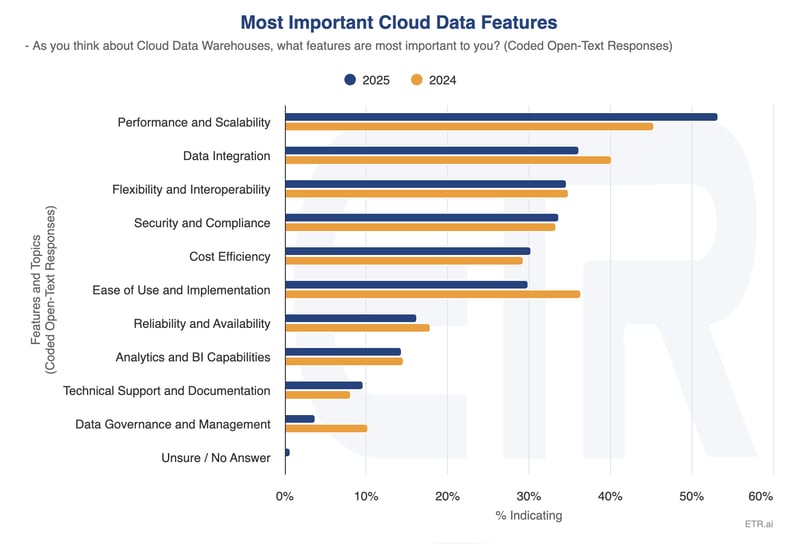 In the 2025 ETR Observatory for Cloud Data Warehouses, cost efficiency grew slightly in importance compared to the prior year. Performance and scalability, however, stand out as the most important features for cloud data warehouses.
Cost mattered, but security, flexibility, interoperability, performance, and integration all ranked ahead of it in the survey's open-ended responses. Microsoft remained the vendor most organizations would consolidate around, while Snowflake topped the list on innovation. "Any developer you ask wants to try Snowflake and Databricks and have them on their resume," the cloud infrastructure director said. For the largest enterprises, though, the storage architect argued that "stability and the suite of services and tools are much more important than the momentum of innovation in a particular company." Lasting differentiation, the panel expected, would come from the AI and analytics layers on top of the warehouse rather than the warehouse itself.
That is the baseline the new report will test. Did hybrid become the default? Did Oracle's uptick hold? Did Google close the gap with Microsoft, or did Snowflake and Databricks extend their lead? The Observatory for Cloud Data Warehouses lands on September 30 with the answers. If last year's panel holds, winning in cloud data warehousing will require pragmatism, hybrid tolerance, and foundational data discipline over single-vendor promises. Until then, the complete 2025 panel conversation and dataset are available on the ETR Platform for ETR subscribers. Compare last year's momentum leaders against the field, then see which of them kept it when the new numbers drop.