

IT Spending Momentum Rebounds for 2026

The Winter 2026 Macro Views Survey data signals a clear but measured rebound in enterprise IT spending expectations: CY2025 growth comes in at 3.7% and CY2026 expectations rise to 4.6%, with 74% of technology leaders planning to increase spend. The Macro Views Survey consistently tracks and updates core trends like budget growth, spending priorities, and organizational shifts by surveying the ETR Community, a body of technology leaders with direct budget accountability. “CY” refers to calendar year, so these figures reflect expected year-over-year changes in IT spending, and together they provide a grounded, real-time view of how macro conditions translate into actual enterprise decision making.
This is a “budgets are improving” story, not a “budgets are back” story. The rebound is real, but it remains below last year’s January highs, meaning 2026 planning should assume growth with continued discipline.
Key numbers at a glance
-
CY2025 IT spend growth: 3.7%
-
CY2026 IT spend growth expectation: 4.6%
-
Share planning to increase IT spend: 74%
-
Context: still below January 2025’s higher growth expectations
Winter shows the strongest spending read since 2022
The most important signal in the Winter read is the direction of revisions: expectations moved higher for both the current and next calendar year. That’s a meaningful change from the “pause and reassess” posture that has defined much of the last few years.
The breadth of intent matters, too. With 74% planning to increase IT spend, the market is shifting from caution to commitment, but mainly toward initiatives that are already prioritized, resourced, and measurable. In other words, leaders aren’t green-lighting everything; they’re green-lighting what they can justify.
Optimism broadens across enterprise cuts
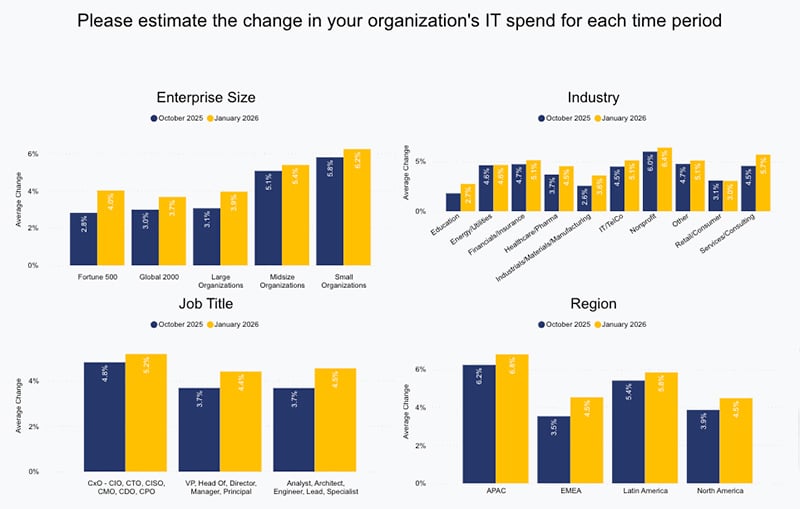
This rebound isn’t confined to one slice of the enterprise, which is one of the healthiest aspects of the signal.
-
Enterprise size: small and midsize organizations remain the most optimistic, but large enterprise is improving meaningfully as well. That matters because Fortune 500 budget cycles move slower; when that segment improves, it often indicates that delayed programs are starting to unstick.
-
Geography: all regions improve versus the prior survey, reducing geographic concentration risk. For vendors and investors, that supports more balanced assumptions across global pipelines and expansion motion.
-
Role seniority: sentiment improves across job levels, with the most senior leaders among the most optimistic. That’s a reminder that spend is increasingly tied to business outcomes—so the best-performing narratives will be executive-ready, not just IT-functional.
Why this is not a return to 2024 behavior
Even with better momentum, the spending posture still trails last year’s January highs. That gap is the difference between broad-based expansion and targeted growth.
Technology leaders remain selective, and “selective” has a consistent pattern in 2026: faster approvals for initiatives with visible ROI, operational impact, and risk reduction and slower approvals for nice-to-have expansions. In practice, that usually means spend flows first to areas like security posture improvements, cloud optimization, automation, and programs tied to cost-out or revenue enablement (where outcomes can be quantified).
The mix of spend reinforces the same point. Increases are more likely to support executing and scaling prioritized work, such as accelerating new projects and expanding cloud resources, while net-new vendor adoption remains comparatively limited. That shifts the growth playbook: expansion inside existing accounts and proof of time-to-value often outperform broad “land” assumptions.
Discipline also persists in the downsell cohort. A meaningful minority still expects to reduce spending, and the most common levers tend to be staffing costs and vendor consolidation. Layer AI on top, and the bar rises further: leaders are increasingly evaluating technology through a productivity lens—how much work it removes, how quickly it pays back, and how reliably it scales.
Takeaways for vendors and investors
-
Plan for growth that is real, but targeted. 2026 looks more like disciplined execution than broad expansion.
-
Win with measurable outcomes. ROI clarity, faster deployment, and tangible operational impact are the new “price of admission.”
-
Expect expansion to outperform greenfield. If new vendor adoption is constrained, account growth comes from deepening value, not just adding logos.
-
Treat the rebound as broadening, not booming. Improving sentiment across sizes and regions supports healthier planning, but doesn’t justify 2024-style assumptions.
Use the Winter 2026 Macro Views Findings Report as your baseline for 2026 planning and pressure-test assumptions against where technology leaders are most willing to fund execution versus experimentation. Complete the form below to have the summary emailed to you and to gain access the findings report.