

Security Spend Stays Resilient as AI Reshapes IT Budgets

AI is redrawing enterprise IT budgets line by line, and security is the one category the redrawing does not touch.
Key Takeaways
-
Security software leads all software subcategory growth at 7.8%, more than four times human capital management (HCM) software at 1.9%, even as overall software growth slowed to a one-year low of 3.6%.
-
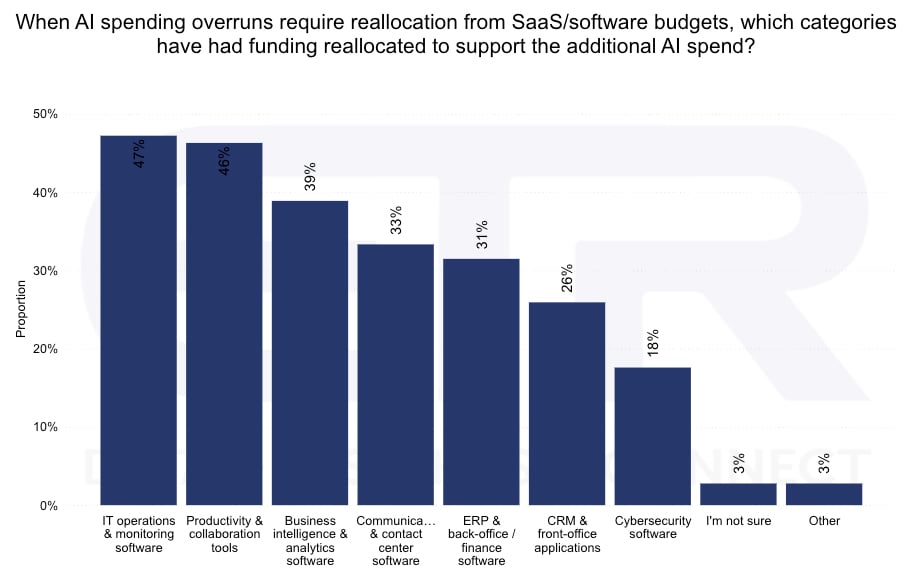
When AI overruns force software cuts, just 18% of organizations reallocating software budget pull from security, the lowest of any category; IT operations and monitoring tools (47%) and productivity and collaboration tools (46%) take the hits.
-
Cybersecurity is the IT role least exposed to AI-driven headcount reductions at 23%, versus 60% for IT support and helpdesk.
-
Information security vendors such as CrowdStrike and Fortinet hold healthy Net Scores among both budget-cutters and budget-growers, a sign that security demand holds regardless of budget direction.
Every budget cycle produces winners and losers, and the AI era has sharpened that divide. ETR's Summer 2026 Macro Views Survey shows AI pulling funding from contractors, legacy infrastructure, and non-AI software while headcount plans tighten across IT. Through all of it, one category keeps its funding, keeps its people, and keeps growing faster than everything around it: security.
What Is the Macro Views Survey?
The Macro Views Survey is a recurring survey that captures forward-looking enterprise IT budget expectations, pricing trends, AI deployment strategies, and organizational priorities directly from the people who set and manage those budgets. The Summer 2026 iteration was fielded from June 2 to July 5, 2026, and drew 1,636 technology leaders, including 275 from Fortune 500 and 393 from Global 2000 organizations.
How Is Enterprise IT Spending Shifting in 2026?
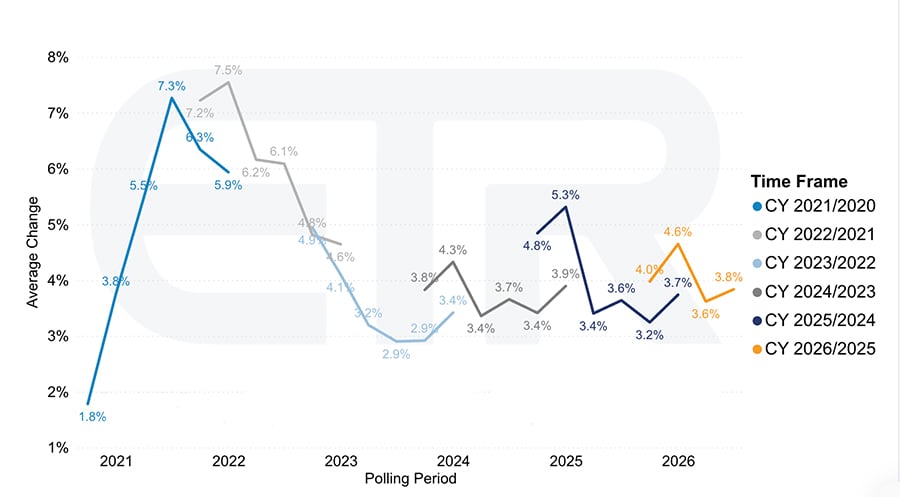
The enterprise IT spending landscape is settling into a new reality shaped by the financial ripple effects of AI. Calendar year 2026 IT spending growth reached +3.8% in the Summer 2026 survey, an uptick from Spring's +3.6% but still trailing the +4.6% technology leaders projected in Winter 2026. While 72% of organizations plan to increase IT spending, Small organizations (4.8%) and the Energy/Utilities vertical (5.6%) are driving the strongest momentum.
The most notable shift is occurring within infrastructure. Hardware spending growth accelerated to 4.0%, overtaking software, which slowed to a one-year low of 3.6%. That shift comes at a premium: hardware pricing climbed to 6.9% year over year, up from the 5.5% reported in Spring 2026. Cloud remains the largest spending growth category at 7.5%, despite easing from 7.9% earlier in the year.
Which Software Category Is Growing Fastest in 2026?
Against that cooling software backdrop, security software leads every subcategory ETR tracks, with expected spending growth of 7.8% in the Summer 2026 survey. That is more than four times the growth rate of HCM software, which trails the field at 1.9%. Data and business intelligence software follows security at 7.3%, while productivity and collaboration (5.0%) and sales and marketing software (4.3%) both accelerated from Spring 2026.
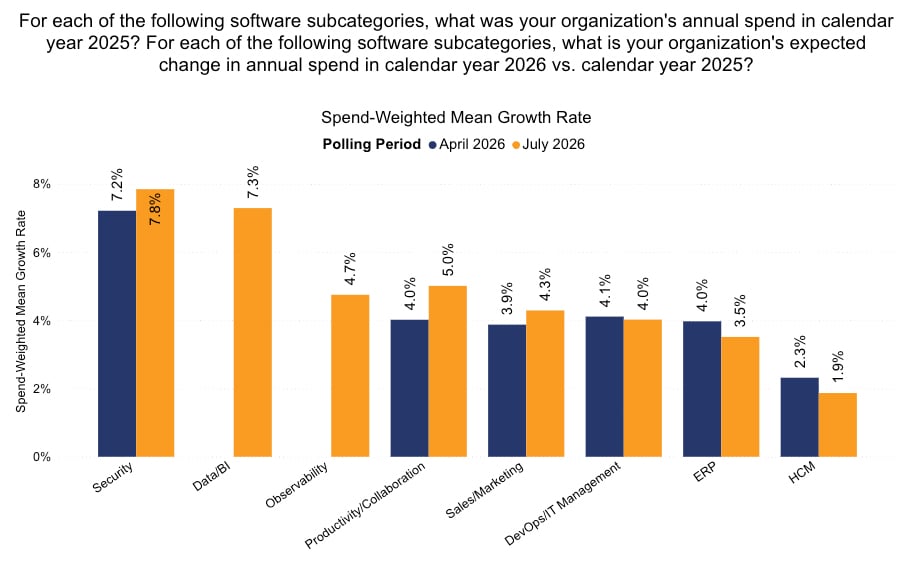
The context makes that number more meaningful, not less. Growth is easy to explain when everything is moving up. With the overall software category at its lowest level in a year and now trailing hardware, security is not just outgrowing its peers. It is growing at more than double the software mean while the mean falls.
What Gets Cut When AI Budgets Run Over? Not Security.
The sharper test of budget priority is not what grows when money is available. It is what survives when money runs short. AI is providing exactly that test: 47% of organizations report AI spending moderately or substantially over plan this year, and among those reallocating budget to cover the overruns, the cuts land on external contractors and consultants (61%), legacy infrastructure modernization (49%), and non-AI software licenses (36%).
Within software specifically, the harvest is concentrated. Among respondents pulling from non-AI software licenses to fund AI overruns, IT operations and monitoring software (47%) and productivity and collaboration tools (46%) are the most cited categories to cut, followed by business intelligence and analytics software (39%) and communication and contact center software (31%).
Security sits at the bottom of that list, and it is highly insulated. Just 18% of respondents reallocating software budget pull from cybersecurity, the lowest share of any category and consistent with what ETR observes across several of its data sources. When technology leaders are forced to choose which software funds their AI ambitions, security is the category they choose last.
Is AI Coming for Cybersecurity Jobs?
The protection extends to personnel as well. AI adoption is now near-universal, with just 4% of organizations not leveraging AI, down from 10% a year ago, and the labor impact is measurable: limiting future headcount (34%) and strategically reducing headcount (20%) due to AI both reached their highest levels to date this survey.
Those reductions are not evenly distributed. Among respondents reporting AI-driven headcount reductions, IT support and helpdesk roles are the most exposed at 60%, followed by software and application development (58%), IT operations and infrastructure (53%), and IT administration and back office (51%). Cybersecurity is the least affected IT area at 23%.
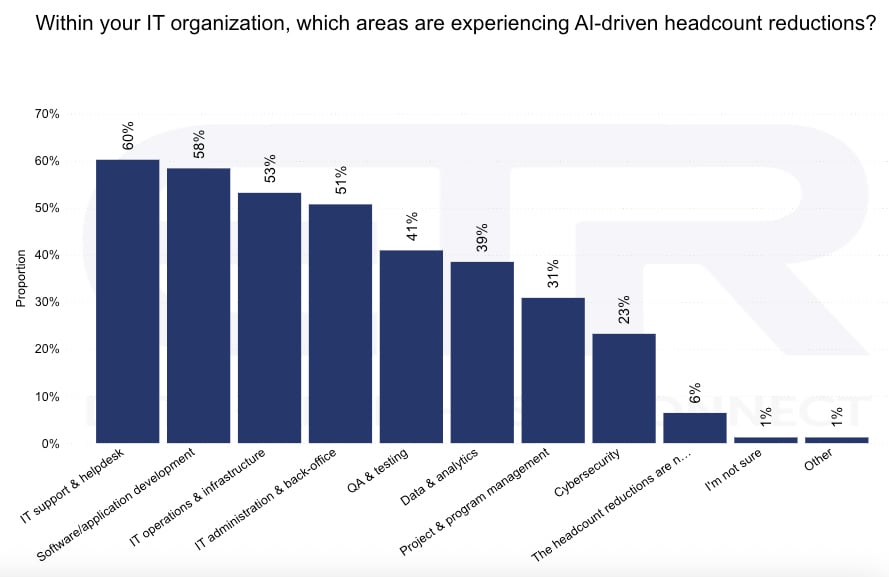
The pattern is coherent. Organizations are automating routine and repeatable IT work, and they are declining to automate the function that manages risk. Security expertise behaves like the budget it sits in: protected on the way down, prioritized on the way up.
Why Security Demand Holds Regardless of Budget Direction
Security posts the cleanest protected-spend narrative in the Summer 2026 data, and it passes three separate tests in the same survey. On growth, it leads every software subcategory at 7.8% while the broader software market slows to a one-year low. On reallocation, it is the last category technology leaders cut when AI overruns force hard choices, at just 18%. On labor, it is the IT function least exposed to AI-driven headcount reductions, at 23%.
The vendor-level data reinforces the category story. ETR measures vendor momentum with Net Score, and it tracks that score separately for customers increasing their overall IT budgets and those cutting them. Within information security, CrowdStrike leads the sector and holds a positive Net Score even among customers reducing overall IT spend, and Fortinet posts a similarly narrow spread between budget-cutters and budget-growers. Demand that persists among organizations actively shrinking their budgets is the strongest signal a spending survey can produce.
For investors, the conclusion is direct: security demand holds regardless of budget direction or AI reallocation. AI may decide which categories fund its overruns, and macro caution may decide how fast overall budgets grow, but neither force is touching security. In a year when nearly every line item has to justify itself against an AI alternative, security is the line item that does not have to.
Get the full picture. The complete Summer 2026 Macro Views Survey Findings Report covers IT spending by category and vertical, hardware and software pricing trends, AI budget governance, and vendor-level Net Score movements across spending profiles. Complete the form below to download the summary and gain access to the complete report.