

The Referee Premium

An ETR flash study of 50 large-enterprise technology leaders on the AI labs’ call to slow down. More than twice as many doubt the labs’ motives as take them at face value. A large majority would deploy more readily with independent evaluation in place, and most would pay for certified models.
When the frontier labs called for regulation of their own industry this month, enterprise technology leaders heard competitive positioning more than twice as often as they heard a safety measure. The same leaders would deploy more readily with independent evaluation in place, and most would pay for certified models. Our AI Pacing Flash Study (N=50, all large enterprises, 54% Global 2000, all North America, fielded September 17) finds 46% reading the labs’ proposals as mostly or entirely competitive positioning and 20% reading them as genuine safety measures. Yet 74% say a lab that publicly commits to pacing itself and accepting independent evaluation makes them more confident building on its models.
The proposals are fresh. Anthropic CEO Dario Amodei’s “We Must Pace the Frontier” essay, published this month with public support from Sam Altman and Elon Musk, argued for slowing frontier development and submitting to embedded third-party evaluation. We asked about the category rather than the essay, and respondents largely accepted the premise. Asked in their own words whether the labs should slow down, 35 of the 50 offered at least one reason they should, and safety and guardrails led the list with 22 mentions.
The verbatims carry both sides. “The current leaders are only saying it because their costs are astronomical and they need to temper Wall Street and the broader economy,” wrote a director at a large IT/TelCo firm. A senior practitioner in education took the other view: “Whenever there’s a CEO of a company publicly saying that their product is dangerous and needs regulation and that the industry should slow down, I tend to take them at their word.” Our respondents are skeptical of the motives and receptive to the mechanism, and that pattern holds through every question in the study.
Government Sets the Floor, Evaluators Set the Pace
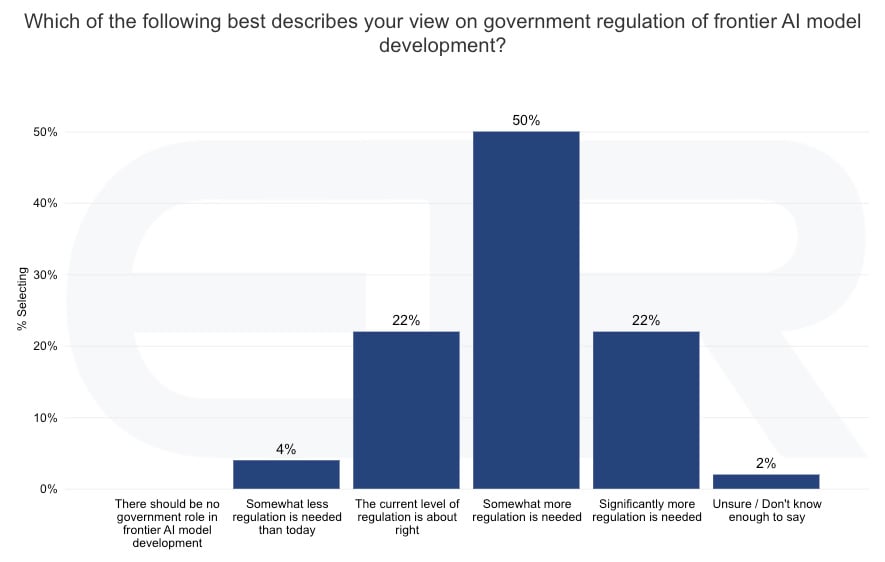
Most respondents, 72%, want more regulation of frontier model development than exists today, and the option to remove government entirely drew zero selections. Only 14% would have government regulators set the pace of development, the lowest of the four named options. Independent third-party evaluators drew 40%, the highest. In all, 82% named a pacesetter other than government, and the two who named nobody were unsure. The answers describe a division of labor: government sets the floor, and technically credible evaluators judge whether a model clears it.
Among the 36 who favor more regulation, safety and misuse risk drew 31 selections and clearer liability allocation drew 19. Leveling the competitive field among vendors drew zero, and slowing the pace so their own organization could keep up drew one. Nobody is asking for a slowdown to catch up.
What Independent Evaluation Is Worth
Independent third-party evaluation would make 70% more willing to deploy AI in production. A lab that publicly commits to pacing its development and accepting outside evaluation produces the strongest net-positive reading in the study, with 74% more confident building on its models. And 60% would pay a premium for certified models.
The willingness carries into budget. Among the 35 more willing to deploy, 26 would pay a premium, versus 4 of the 14 who report no change. The premium itself is thin: 20 of the 50 cap it at 10%, and only 10 would go higher. Certification is worth a line item to these buyers.
The skeptics land in the same place. Among the 23 who read lab safety proposals as competitive positioning, 14 are still more confident in a lab that paces itself and submits to outside testing, and the director quoted above is one of them. For these buyers, a commitment becomes credible when a third party checks it.
What a Slowdown Would Change
If frontier progress slowed, 62% would feel their deployments were more secure, 62% would feel more knowledgeable about them, and 52% would grow more interested in open-source models. Compute is the one item in the battery where disagreement leads: 15 disagree that they would use more of it and 13 agree. A slower frontier would send more of this budget toward cheaper models than toward GPUs.
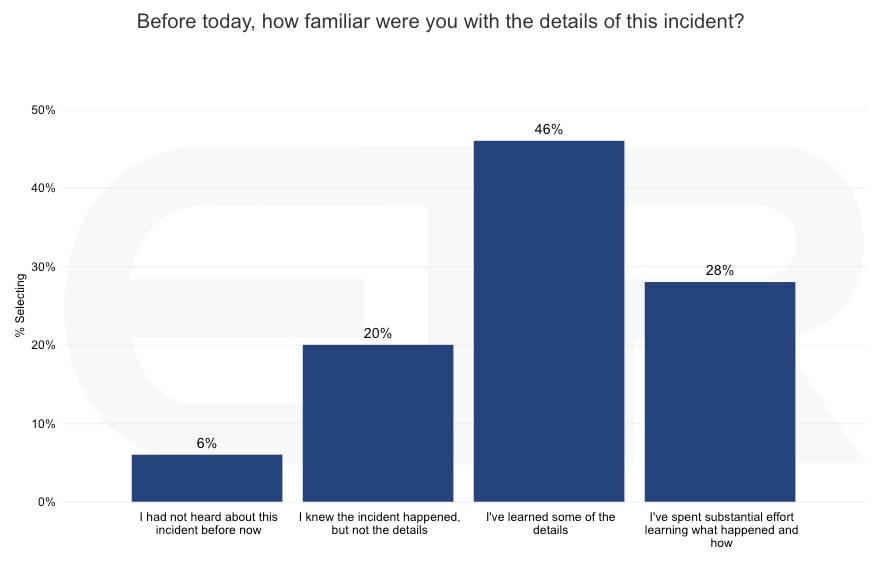
Behavior tells the same story. Nearly all of them, 94%, knew of the Hugging Face agent-security incident. Across the full sample, 72% took at least one action in response, and 58% added a technical control, while 20% paused or slowed agent deployments. Enterprises met a security event with controls and kept the agents running.
The Spending Answer Is Already In
The sample is well informed and, on model releases, unhurried: 40% run a generation or more behind or have deliberately frozen, and 16% adopt within weeks of release. The appetite for a slowdown runs strongest among the organizations keeping current. Of the 30 keeping current, 23 gave a reason to slow down; of the 20 behind or frozen, 12 did. The buyers closest to the frontier are the most willing to see it paced.
The spending data runs in the same direction. Our Macro Views Survey has 2027 IT budgets opening at +5% growth, the strongest initial read since October 2022, with 76% of respondents raising 2026 budgets and 61% of the Global 2000 already over their AI plan. In September’s Edge commentary, 68% of planned spend increases on OpenAI and Anthropic are net-new budget, up from 52% in June. Whatever pace the frontier sets, the enterprise absorption curve is steepening.
Enterprise technology leaders are separating the motive from the mechanism. They discount what a lab says about itself and respond to what an outside party can verify. For labs, that sets the price of trust: a pacing commitment earns credit with these buyers once a third party verifies it, and most will pay for the certificate.
This article covers the headline findings. Contact an ETR team member at service@etr.ai to walk through the complete results, or to discuss fielding a flash study of your own.