

Top 5 Insights from 2025 Drill Down Surveys

The ETR Community is one of the best sources of real end-user insights about enterprise tech in the industry. When we gather responses from the ETR Community in our quarterly Technology Spending Intentions Survey (TSIS), we can target users of specific products or IT decision makers with insight into specific technical areas for follow-up investigations. Many of these follow-up projects, called drill down surveys, are commissioned by clients, and as such, are exclusive; however, in 2025 ETR produced 20 drill down surveys of our own to enrich our analysis of the enterprise IT landscape.
We’ve plucked five interesting findings from a selection of these diverse research projects in 2025. Read on for some of the highlights.
Vulnerability Management and Identity Top Priorities for Security
In March 2025, ETR’s Annual State of Security survey gathered responses from 500 IT decision makers with purview over information security spending, widening its reach from the previous year (N=321 in 2024). The survey tracked data on the impact of AI on security, outsourcing in security, broader spending plans, and more.
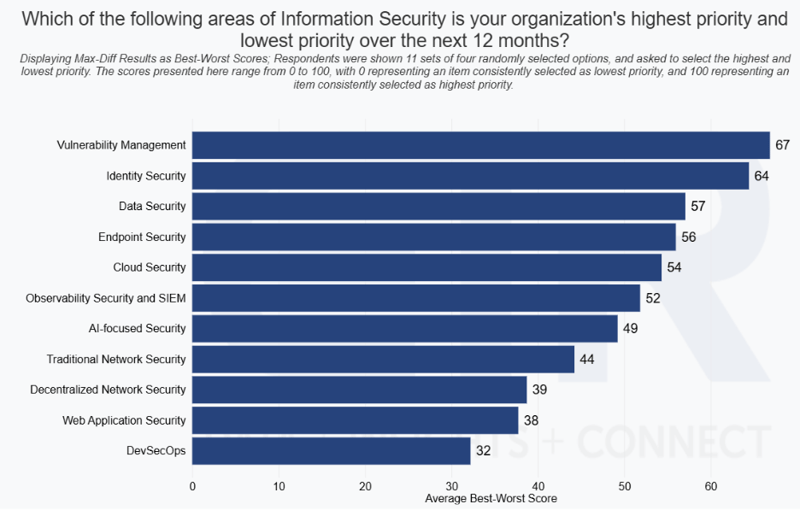 One of the more interesting findings from the survey was a maximum difference scaling question – also known as a Max-Diff technique – that identified the highest priorities in the security domain by ranking subsets of options across the entire survey respondent pool. Security leaders ranked vulnerability management the highest priority security area for the coming year, followed by identity security. Data security, endpoint security, and cloud security followed next, in order. DevSecOps, web application security, and decentralized network security were the lowest-ranked security priorities for the year ahead.
Security the Most Insulated Area When it Comes to Spending Cuts
In April 2025, ETR conducted a survey of 219 C-suite respondents, including 23 from Global 2000 organizations, exploring how spending priorities had changed since the start of 2025, when a number of major macroeconomic and geopolitical changes started rolling out. The survey examined specific areas of increasing and decreasing spend, primarily, including cloud computing, outsourced services, IT personnel, and on-premises infrastructure.
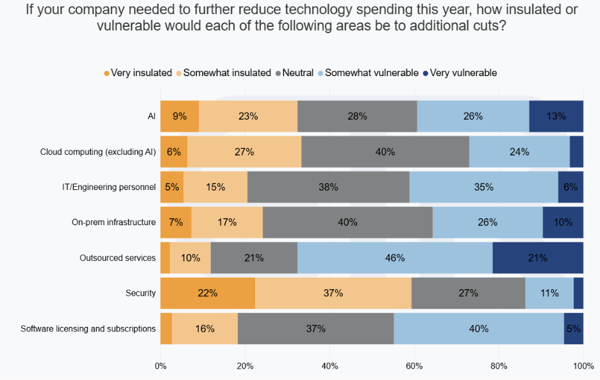
In a hypothetical question, these C-suite respondents were asked how vulnerable or insulated some areas would be to additional cuts if their company needed to reduce technology spending further. The results show security as the most insulated area, with more than half of respondents (59%) indicating security would be very or somewhat insulated from cuts. Outsourced services was the most vulnerable area, with two-thirds (67%) indicating it was somewhat or very vulnerable to cuts. Cloud computing and AI were the next most insulated spending areas.
Wiz Customers Generally Positive About Google Acquisition News
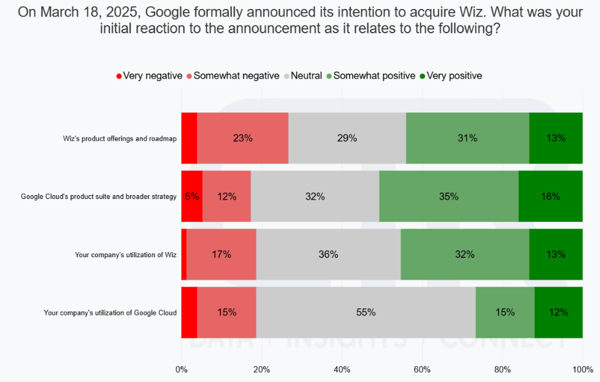 Following the March 2025 announcement that Google intended to acquire cloud security company Wiz, ETR fielded a survey in May to gauge sentiment about the acquisition. With more than a third from Global 2000 organizations, 75 IT decision makers and current Wiz users responded to the survey, rating Wiz’s features, performance, initial reactions to the acquisition, and impact on likelihood to continue with the vendor.
Wiz’s customers’ initial reactions to Google’s intent to acquire the company were more positive than negative on the whole. More than half (51%) of respondents either had a somewhat or very positive opinion of Google Cloud’s product suite and broader strategy, higher than the 43% who had a very or somewhat positive impression of Wiz’s product offerings and roadmap. More than a quarter (27%) had a very or somewhat negative opinion of Wiz’s product offerings and roadmap, however, in an initial reaction to the announced acquisition.
Cloud Workloads Will Grow
In addition to its annual State of Security survey, ETR conducts an annual Cloud Survey in August. The survey of 300 IT decision makers tracks cloud workload growth, reasons for repatriation, reasons for diversifying and consolidating vendors, impacts of AI, and more.
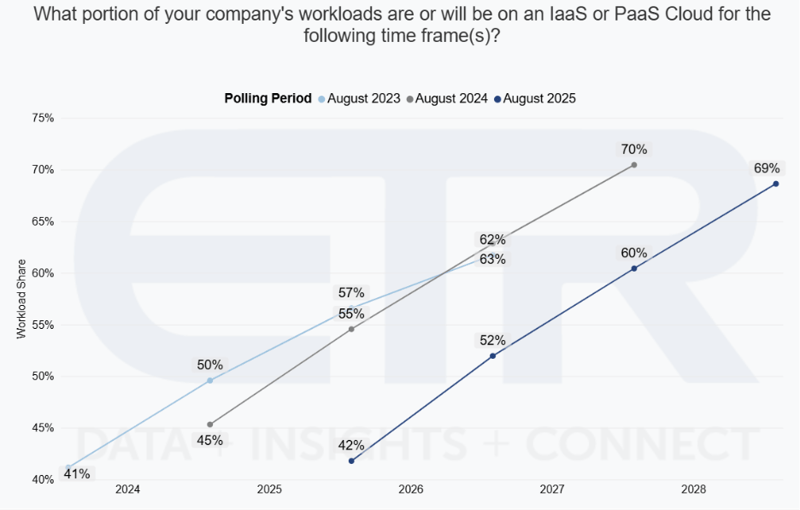
One of the more revealing findings from this annual survey is the estimated portion of workloads that are anticipated to be on IaaS or PaaS cloud in the future. Consistently, respondents overestimate the portion of workloads that will be in the cloud in the future, as each year’s current snapshot falls short of previous years’ one-year-out estimates. This is no doubt a testament to how difficult the realities of cloud migration can be compared to idealistic plans. Still, the 2025 data show respondents have high hopes for growing cloud workloads in the future. Currently at 42% of workloads in the cloud, respondents estimate by late 2026 more than half (52%) would be in the cloud, and by 2027 as much as 60% of workloads would be in the cloud.
Software Development Most Affected by AI in the Future
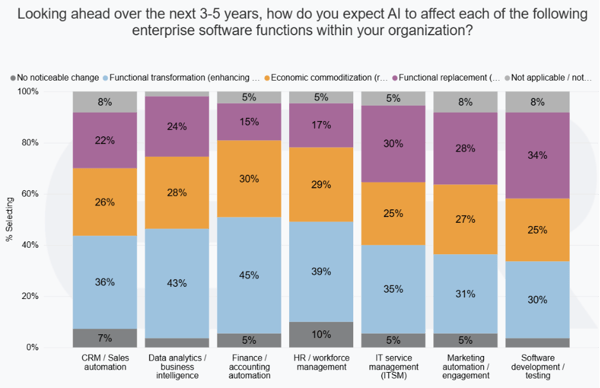 In an October 2025 drill down survey, 110 C-suite and VP/Director-level respondents provided insight into the impacts of AI on SaaS. The survey asked about current and future employee interactions with enterprise systems, AI agent use, and more.
One question in the survey asked respondents how they expect AI to affect various enterprise software functions in the next 3-5 years. Respondents expected software development and testing to be the most affected by AI, with 34% indicating a functional replacement (i.e., AI takes over key tasks), and another 25% indicating economic commoditization (i.e., reducing differentiation or cost). HR/workforce management and finance/accounting automation appeared to be the least affected. A tenth (10%) of respondents thought HR/workforce management would see no noticeable change from AI in the next 3-5 years, and 39% anticipated functional transformation (i.e., enhancing existing tools). For finance/accounting automation, 5% anticipated no noticeable change, but 45% anticipated some functional transformation. Both areas had the lowest levels of anticipated functional replacement by AI.
Drill down surveys and custom research from ETR are a great way to get deeper insight into specific lines of thinking about a variety of topics and vendors. Clients have used this service to gauge nuanced ideas about product features during the product development process, to test price sensitivity in target markets, to get answers to hypothetical questions about budget pressures, to size-up competitive threats, conduct brand awareness and win/loss campaigns, and to read the terrain of unfolding tech landscapes and new trends.
This year, ETR also conducted vendor-specific drill down surveys on vendors like Rubrik, Cloudflare, Atlassian, CrowdStrike, GitLab, and many more, and as always, the quarterly Macro Views Survey is part of this coverage.
If you’re interested in getting juicy insights like these of your own, reach out to service@etr.ai to discuss your project. We source this insight from our large and growing ETR Community of qualified technology leaders, the same engine that powers our 15 years of industry-leading data on enterprise IT spending intentions.