

VMware Customers Face A Cost Reckoning

There is a quiet negotiation happening across enterprise tech right now, and most organizations do not realize they are already losing it.
VMware customers are not just reacting to higher prices. They are reassessing what the platform is worth, how much leverage they have, and whether staying put is still the safest option.
That was the central theme in ETR's VMware Feedback Panel, where senior tech leaders discussed the impact of Broadcom's acquisition of VMware. The panelists described a vendor strategy that appears designed to retain fewer, higher-spend customers through pricing changes, bundling, longer contracts, and shifting licensing models. For some organizations, especially those in regulated industries, VMware Cloud Foundation remains deeply valuable. For others, the economics are forcing a serious look at Microsoft, Nutanix, Red Hat, and other alternatives.
The result is not a simple "leave or stay" story. It is a story about negotiation leverage, migration readiness, executive scrutiny, and the rising cost of infrastructure decisions that once felt settled.

Broadcom Appears To Be Choosing Its VMware Customers
The panelists broadly interpreted Broadcom's post-acquisition approach as intentional, not accidental. In their view, VMware is being repositioned around fewer, larger, higher-paying accounts.
One panelist put it directly: "Broadcom figured out that they don't need that many customers. They will charge very large corporations, hyperscalers, a lot more money, and have fewer customers."
That interpretation matters because it reframes the pricing discussion. Customers are not only asking whether VMware is more expensive. They are asking whether Broadcom is using price, contract terms, and bundling to sort which customers it wants to keep.
The data supports the frustration. In ETR's December 2025 survey on VMware, 71% of respondents said prices have increased substantially more than broader software market pricing since Broadcom's acquisition, up from 63% in October 2024. The share saying VMware products have become available only as part of bundled purchases also rose, from 40% in October 2024 to 49% in December 2025.
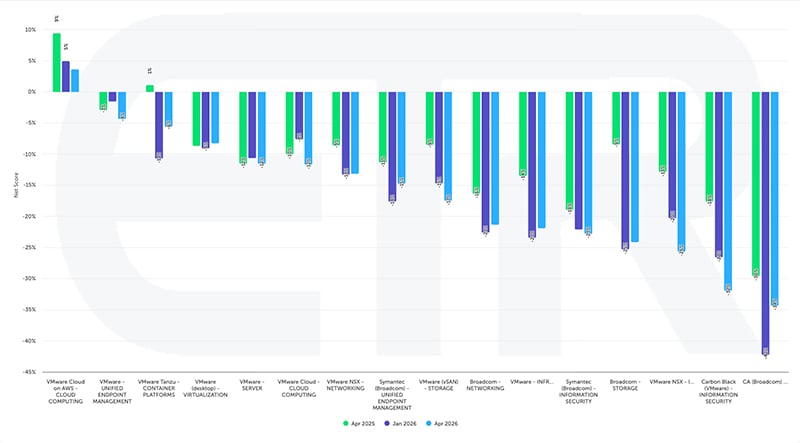
Nearly all products in Broadcom's portfolio are showing substantial Net Score declines in the January 2026 Technology Spending Intentions Survey (TSIS). The one exception, VMware Cloud on AWS, sits in single-digit positive territory. These are not the numbers of a company fighting for market share. They are the numbers of a company managing a transition.
The message from customers is clear: VMware is still important, but the commercial relationship feels materially different.
Renewal Timing Has Become Negotiation Leverage
One of the most useful insights from the panel concerns how leverage actually works. Pricing power is not hitting every VMware customer the same way. It depends heavily on timing and readiness.
Organizations approaching renewal without a credible migration plan described having limited flexibility. As one global IT director said, "Depending on when your renewal cycle was coming up, it kind of forced your hand into potentially a longer-term commitment than maybe you would want," adding that "VMware-Broadcom wasn't real flexible on that front."
That is a difficult position for infrastructure leaders. VMware is often deeply embedded in operations, security, compliance, automation, and application delivery. Moving away from it is rarely fast or simple.
But the panel also made the opposite point: organizations with active migration plans gained leverage, even if they did not ultimately leave. One panelist described a colleague at a major logistics company who was "forced into a five-year commitment at the elevated costs" without sufficient runway to migrate quickly. His own organization responded differently by accelerating exits specifically to preserve optionality.
Migration readiness is no longer just an exit strategy. It is a negotiation strategy.
For IT leaders, the lesson is practical. The time to evaluate alternatives is before renewal pressure forces the decision. Once the deadline is close and the environment is not ready to move, the vendor has the stronger hand.
Bundling Is Increasing Executive Scrutiny
Bundling emerged as a major source of frustration. Customers described paying for capabilities they did not need because those products were included in broader packages.
One privacy engineering lead at a large healthcare manufacturing firm said, "We end up getting, like, six solutions, but we have four extra that we still have to pay for because it's part of a bundle."
That frustration is no longer confined to infrastructure teams. It is moving up the org chart. The same panelist said, "Our CFO and CTO, their biggest ask that's getting pushed down to us is, show us value for each item that is on the [VMware] list."
This is where the VMware conversation becomes bigger than VMware. Enterprise technology leaders are facing a broader budget environment where every platform has to prove its value, especially when contracts are larger, longer, and harder to unwind.
The problem with bundling is not only cost. It is accountability. If a customer is paying for six solutions but actively using two, the internal burden shifts to IT to justify the full spend. That creates new pressure to audit usage, document value, and compare alternatives, and it creates a direct line between vendor pricing decisions and C-suite scrutiny.
AI Adds A New Layer Of Cost Volatility
AI is changing the infrastructure cost equation in ways that interact badly with VMware's new licensing approach.
As AI deployments scale, GPU-based licensing is creating fresh unpredictability. The senior director of data center AI engineering at a large technology manufacturer described the challenge directly: "The model in terms of how they charge is by GPU core. Today, for AI, we have millions of GPU cores. Now, their model has completely made the cost exponential compared to what we had with the perpetual model."
That captures a larger issue. As vendors shift from perpetual licensing to multi-year subscriptions, and as AI changes infrastructure consumption patterns, customers are losing the cost predictability they previously had.
For enterprises trying to plan AI investments, this is not a small concern. GPU-heavy environments can scale quickly. If licensing models do not align with how AI infrastructure is actually consumed, cost models can break faster than expected, and the bill lands in an infrastructure budget that was not designed to absorb it.
VMware Still Has Strong Defenders
Despite the frustration, VMware is far from being dismissed.
Some regulated enterprises continue to defend VMware Cloud Foundation because of its security, compliance, and operational cohesion. A financial services executive who oversees more than 100,000 VMs was direct about why alternatives such as KVM do not fit that environment: "For security reasons, KVM is not the platform of choice from a security perspective. We cannot satisfy a monitoring perspective. We cannot satisfy a compliance perspective, for a regulated company."
For this executive, VMware's integration still matters. "It became tighter. It became cleaner. It became a single console manager." The trade-off, in their words: "It's a blessing. It's an expensive blessing, but it's still a blessing."
That phrase may be the most accurate summary of VMware's current position for a meaningful segment of its customer base. It is expensive. It is frustrating. But for certain enterprises, it still solves problems that alternatives do not solve as cleanly.
This is why the migration conversation is nuanced. Customers may dislike the commercial changes and still conclude that VMware remains the best operational fit.
Microsoft, Red Hat, And Nutanix Are Gaining Attention
Even with VMware's continued value for some customers, others are actively evaluating alternatives.
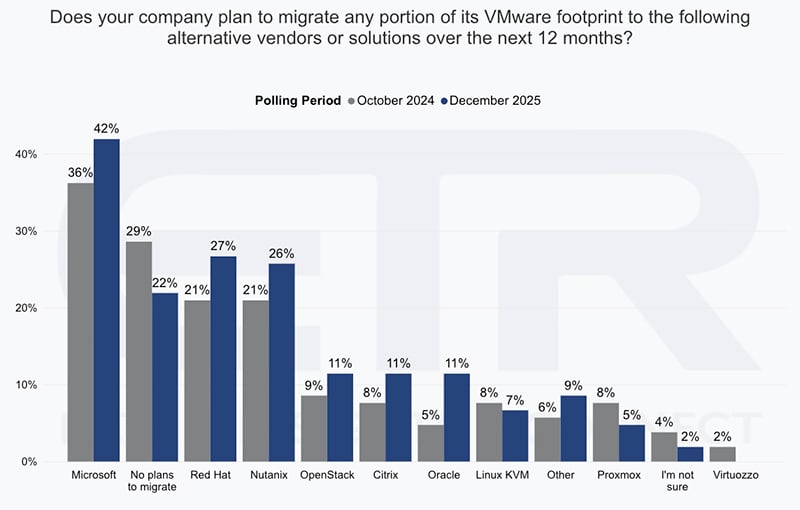
In ETR's December 2025 drill down survey, 42% of respondents said they planned to migrate some portion of their VMware footprint to Microsoft in the next 12 months. Red Hat followed at 27%, and Nutanix came in at 26%. All three saw growth in planned migrations between October 2024 and December 2025. Less than a quarter, 22%, said they had no plans to migrate from VMware in the next 12 months.
Microsoft appears to be benefiting less from innovation than from stability. One manufacturing IT leader said, "We have a very long-standing and very strong relationship with Microsoft. They're our cloud provider of choice with Azure. There wasn't a huge amount of comparison." Familiar contracts, low negotiation friction, and minimal internal disruption are winning market share while Broadcom asserts control.
Nutanix is being evaluated as the more technically comparable option. One senior infrastructure leader described Nutanix Flow as "almost one-for-one with what VMware could provide," while acknowledging that it may take two to three years to realize return and that it "is an expensive solution."
The takeaway is not that VMware customers are leaving overnight. It is that credible alternatives are now part of every renewal conversation.
The VMware Ecosystem May Be The Quiet Casualty
One of the panel's strongest warnings was not about pricing or migration. It was about what happens to the broader ecosystem.
VMware has long supported a marketplace of smaller vendors, integrations, and specialized tools built around the platform. One executive described VMware as "almost a way of life or a religion." That ecosystem may now be weakening as smaller vendors lose certification or struggle to adapt.
"Some of our smaller vendors, they used to be certified by VMware and now they aren't. They basically have to close the shop, or reorient their product on another virtualization platform," one panelist said.
That matters because ecosystems create flexibility. Smaller vendors often solve niche problems that larger platforms do not prioritize. If that ecosystem erodes, customers may face fewer integration options, more concentrated vendor power, and a heavier burden on internal teams to fill the gaps.
For buyers, this is a second-order risk worth tracking. The cost of VMware's commercial changes may not only show up in the VMware contract. It may show up in the surrounding tooling, partner landscape, and operational workflows built around the platform.
What VMware Customers Should Do Now
The panel points to a clear set of actions for enterprise technology leaders.
Assess renewal timing before pressure forces the decision. Waiting until a contract deadline approaches reduces leverage on every dimension. Build a realistic migration readiness plan, even if the organization expects to stay. Optionality changes the negotiation dynamic, and demonstrating credible alternatives is now a prerequisite for maintaining flexibility.
Audit bundled products and document which capabilities are actively used, which are redundant, and which can be justified with measurable value. The internal pressure to show value per line item is real, and being prepared for that conversation is as important as the vendor negotiation itself.
Model AI infrastructure growth carefully. GPU-based licensing and subscription transitions can create cost exposure quickly if planning assumptions are outdated. And evaluate ecosystem risk alongside platform cost. If smaller vendors or integrations are losing support, that may affect the real total cost of staying.
The goal is not to rush into migration. It is to make sure staying is a deliberate decision, not the result of limited time, limited options, or limited visibility.
The New VMware Reality
Broadcom's strategy is forcing a new level of discipline on enterprise customers. Some will stay because VMware Cloud Foundation still delivers the security, compliance, and operational cohesion they require. Others will use Microsoft, Red Hat, Nutanix, or other alternatives to reduce exposure, regain leverage, or avoid long-term lock-in.
Either way, VMware is no longer a quiet infrastructure constant. It is now a boardroom and budget conversation.
The customers that navigate this moment best will be the ones that understand their actual platform value, know their migration options, and enter renewal discussions with more than frustration. They will enter with data.
This article draws on findings from ETR Insights 463: VMware Feedback Panel (February 2026) and ETR's December 2025 drill down survey on VMware (N=105). ETR Insights panels bring together senior technology leaders for in-depth discussions on enterprise technology trends and spending decisions. To access the full ETR Insights panel or request custom research, contact the ETR Insights team.