
Where Enterprise AI Is Actually Delivering

ETR's annual Tech Trends Feedback Panel gathers enterprise IT leaders across industries to surface the trends, vendors, and strategies shaping technology spending decisions. In the 2026 edition, a clear consensus emerged: the era of visionary AI pilots is over, and the pressure is now on governance, cost control, and production-grade outcomes.
Enterprise IT leaders are done experimenting with AI. Organizations are deploying AI in narrow, high-impact use cases, favoring mature data and cloud platforms that can demonstrate real operational value, not just potential. As AI scales across the enterprise, hard realities are setting in around cost, regulatory compliance, security gaps, and data quality. CISOs remain skeptical about AI's defensive impact in cybersecurity, even as attackers move quickly. Spending continues to rise even as license counts fall, a signal that enterprises are shifting toward targeted access, measurable ROI, and enterprise-grade capabilities rather than mass enablement.
Key Takeaways
- AI has shifted from experimentation to execution, with enterprise leaders prioritizing governance, cost discipline, and production-grade outcomes over broad pilots in 2026.
- Enterprises are buying less AI access but more capability — 89% of organizations expect higher AI spending in the next year, even as license counts fall.
- CISOs remain unconvinced that AI meaningfully improves cyber defense; identity-centric, zero-trust architectures have become the foundational security goal.
- The share of enterprises using AI to limit future headcount growth rose from 21% in July 2025 to 30% in January 2026, per ETR's Macro Views Survey.
- Salesforce Agentforce faces growing skepticism; SailPoint is emerging as a lower-cost, high-satisfaction sleeper in the identity market.
Why Are Enterprises Spending More on AI While Buying Fewer Licenses?
The shift from experimentation to execution is the defining theme of 2026. Panelists are deploying modular, multi-agent AI pipelines for unstructured and multimodal data, with Snowflake and Databricks as the most common platforms. ETR panelists increasingly view Databricks as the superior platform for data science and MLOps, while Snowflake is often maintained for traditional analytics and business intelligence, even as ETR's AI Product Series Product Stack data shows Snowflake emerging as an AI ecosystem in its own right.
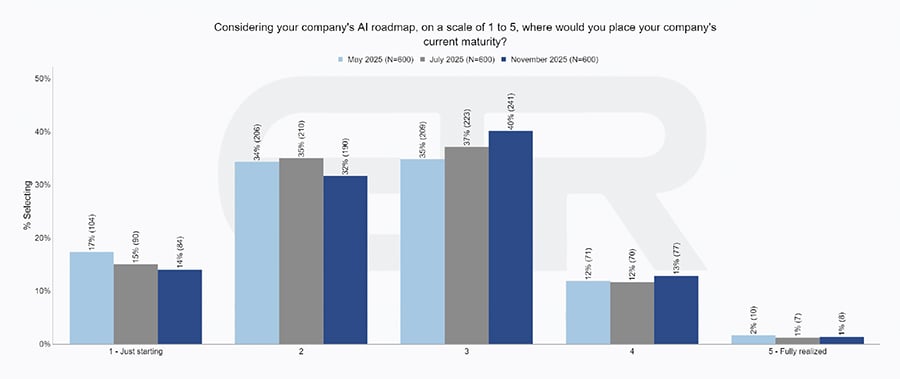
ETR data reinforces this maturation story. According to ETR's November 2025 AI Product Series survey (N=600), fewer than half (49%) of respondents rated their company's AI maturity as a three or higher on a five-point scale in May 2025. By November 2025, that figure had risen to 54%, as those indicating they are just beginning their AI journeys decreased over the same period.
But scaling AI is exposing gaps. For legacy-heavy global enterprises, what works in a proof of concept often fails in production. Security remains a top concern. One Global CISO at a major energy and utilities firm was direct about AI's limitations in cyber defense: no vendor has yet proven that AI meaningfully improves their defensive posture, even as attackers rapidly weaponize it to scale phishing and malware.
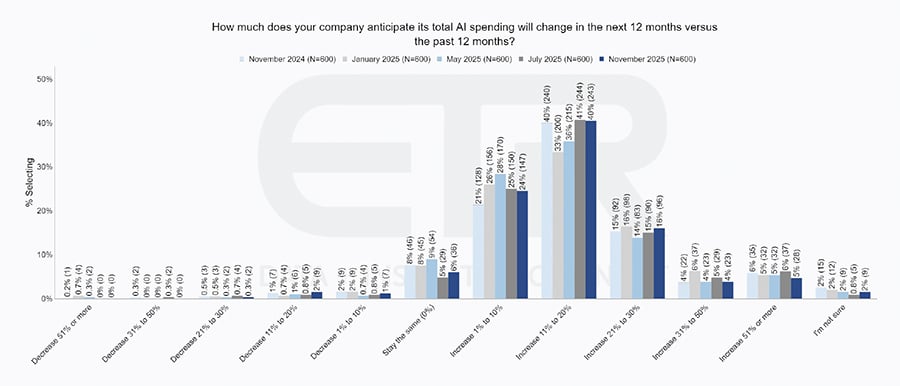
On the spending side, enterprises are buying fewer AI licenses while overall spend rises, driven by tighter governance, more focused use cases, and demand for higher-value capabilities. According to ETR's November 2025 AI Product Series data (N=600), 89% of organizations expect higher AI spending in the next year, and 84% project AI to grow as a share of total tech budgets. As one CISO put it plainly: companies are buying less AI access, but more capability.
How Are Enterprises Approaching AI Governance in 2026?
AI governance structures are evolving quickly, borrowing from earlier data-governance and security frameworks. Data quality has moved to the center of the conversation: organizations that don't control what goes into their models can't control what comes out. Because large language models function as black boxes once fed, enterprises are doubling down on input governance, recognizing that scaling AI without a unified data fabric to manage sensitive PII is a nonstarter.
One Director of IT at an industrial supply company described early AI adoption as a case of "cart before the horse," with legal, security, and business teams initially pulling in opposite directions. Their organization has since established a cross-functional AI committee to evaluate use cases, data readiness, and security implications before scaling deployments. Another panelist likened the current moment to the early days of the internet: full of business appetite and legal uncertainty in equal measure.
Why Are CISOs Prioritizing Zero Trust and Identity in 2026?
AI is accelerating an already-urgent shift toward identity-centric security. While "zero trust" remains loosely defined, its practical implementation centers on ensuring the right users access the right resources at the right time. Panelists use Zscaler and Okta to integrate identity and access management (IAM), identity governance and administration (IGA), SSO, FIDO2 authentication, biometrics, and behavioral signals, balancing security with productivity.
Some CISOs have found success rebranding zero trust as "continuous authentication" when pitching skeptical boards, focusing on context-aware policies that verify device posture and location rather than just user credentials. The strategy is gaining traction regardless of what it's called.
Is AI Reducing Enterprise Headcount in 2026?
AI's workforce impact is becoming more visible, though it plays out unevenly across regions, industries, and job categories. In Europe, strong union protections are limiting direct job displacement, with AI more likely to handle mundane tasks while humans focus on higher-value work. In the U.S., the picture is more turbulent, with retraining of experienced professionals often deprioritized in favor of hiring for adaptability over credentials.
One panelist offered an important reframe: many job losses attributed to AI actually reflect long-delayed modernization. Tasks like processing bills of lading were always going to be automated; AI just accelerated the timeline.
According to ETR's Winter 2026 Macro Views Survey, the share of respondents indicating AI is limiting future headcount growth rose from 21% in July 2025 to 30% in January 2026. Those indicating AI is resulting in strategic reductions to current headcount rose from 14% to 18% over the same period. This is a structural shift targeting inelastic, repeatable tasks rather than broad layoffs.
The clearest illustration came from a senior director at a global logistics company: what once required 30 to 40 people now runs with four or five, with 80% to 90% of workflows automated and humans handling only the outliers.
Which Vendors Are Winning — and Losing — Enterprise AI Mindshare?
IT leaders broadly expect 2026 to be defined by consolidation around a smaller set of trusted vendors, with strong momentum behind Databricks, Snowflake, OpenAI, Anthropic, AWS, and Microsoft, according to ETR's November 2025 AI Product Series survey. Cloud-agnostic platforms like Snowflake and Databricks have become enterprise standards precisely because they aren't tied to a single hyperscaler. Workday and ServiceNow earned praise for seamlessly integrating AI into day-to-day workflows. Teradata and SAS, meanwhile, were called out as vendors that had a front-row seat to the AI era and missed their moment.
On Salesforce, sentiment is mixed. Agentforce has proven useful in specific contexts like call center customer service, but panelists question its broader roadmap. In previous panels, some early adopters have gone further, planning to reduce Salesforce licenses entirely and describing Agentforce as little more than Einstein repackaged.
On the security side, CrowdStrike, Commvault, and Palo Alto Networks all received positive marks. One CISO flagged SailPoint as a vendor to watch, calling it far cheaper and more efficient than alternatives, with strong satisfaction from IDAM teams. ETR survey data backs that up, with SailPoint receiving some of the highest marks for technical support and roadmap quality among identity peers.
Panelists included a Sr. Director of Data and AI at a large logistics enterprise, a Sr. Data Scientist at a large services and consulting enterprise, a Global CISO at a large energy and utilities enterprise, and a Director of IT at a large industrial supply firm.