

Who’s Funding AWS Growth? Azure, Data Centers, and Legacy Vendors

Of 35 technology leaders, 86% plan to spend more with AWS. The bigger signal is which budgets that growth is coming out of.
ETR's Edge Report on AWS gathered qualitative commentary from 35 technology leaders, and 30 of them plan to increase AWS spend over the next six months. Only five plan to cut back.
Hyperscaler demand is not news. The more telling part is the composition: who is gaining, who is losing, and how durable the commitment looks. On those questions, the panel points to share gains against Microsoft Azure, a long tail of on-premises vendors losing workloads, and an AI story that runs through Bedrock. The risks sit in pricing and in Amazon's own footprint outside the cloud.
Key Takeaways
-
Azure is the most-cited donor. Five increasers say their added AWS spend comes at Azure's expense, while only one decreaser is moving to Azure.
-
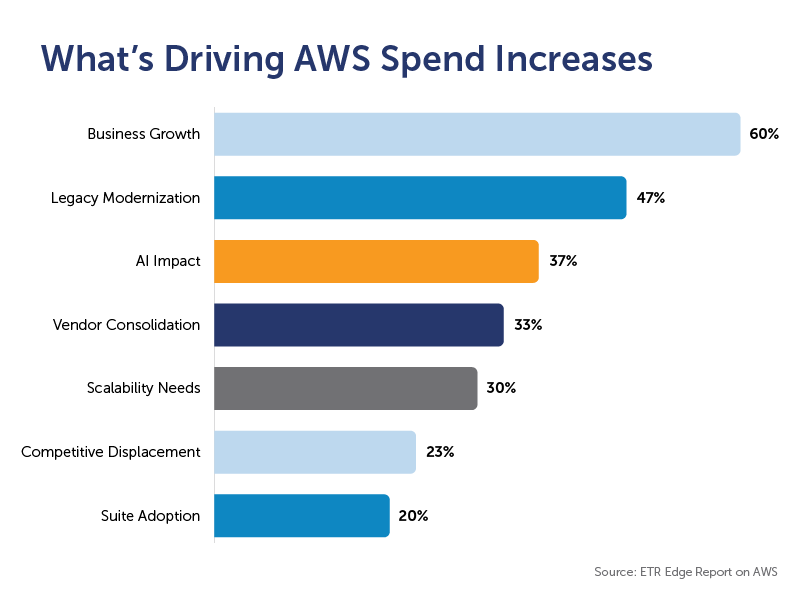
Legacy exits are the base load. Among increasers, 47% tie their growth to modernization, retiring data centers, on-premises databases, and virtualization.
-
AI is a growth driver, not yet the whole story. AI shows up for 37% of increasers, and one already uses Bedrock as a model routing layer.
-
Losses are narrow but price-driven. Only three of five decreasers are moving to a rival, and the clearest defection cites AWS price increases.
Azure Is Losing Workloads
When AWS growth comes from a competitor, Microsoft is the name that surfaces most. Five increasers describe migrating workloads off Azure, reducing reliance on it, or consolidating onto AWS as their primary platform. A Director at a Fortune 100 company said AWS offers "better customer service and more agnostic offerings than Microsoft."
Capacity is part of the story. A Director at a large North American Services/Consulting firm said the organization is formally becoming a multi-cloud shop after "several capacity issues with Azure relating to the buildout of AI workloads." Even Azure-first accounts are hedging. A Director at another large Services/Consulting firm that remains heavy on Azure is adding AWS because "you don't want to put all your eggs in a single basket."
The flow is not one-way. One decreaser is consolidating its AWS footprint onto Azure to reduce overall vendor spend. Against Google Cloud, the ledger is even: two increasers are pulling budget from Google, and two decreasers are moving to it.
Legacy Exits Are the Base Load
The steadiest driver in this panel is modernization. Nearly half of increasers cite legacy migration, and the accounts read like a list of on-premises displacement: ERP systems moving to a hyperscaler model, on-premises SQL warehouses moving to AWS-hosted data platforms, and data center exits tied to product development. Two name legacy virtualization, networking, security, and database vendors as the budget source.
Financial services firms are prominent here. A third of increasers come from the Financials/Insurance sector, and none of the five decreasers do. A Department Head at a Fortune 100 financial services firm described a cloud-first pivot in which every new initiative defaults to the cloud, reasoning that "cloud is more immune from supply-chain shocks and risk."
Commitment looks durable. Two-thirds of increasers explicitly tie their spend to long-term strategy, and only 7% describe it as purely short-term project demand. A VP at a Fortune 1000 IT/TelCo company was blunt: "We would not have been able to grow our products without AWS."
AI Runs Through Bedrock

One account offers a preview of where model economics could go. A C-level leader at a small Services/Consulting company is routing AI traffic through Bedrock as part of a vendor-agnostic strategy, offsetting what it previously spent calling a model provider's API directly. If that pattern spreads, Bedrock becomes a way to capture AI spend regardless of which model wins.
Still, AI is additive rather than dominant. Business growth leads at 60% of increasers, followed by migration and consolidation.
Price and Neutrality Are the Pressure Points
The decreasers are few, and two of them are not leaving AWS at all. One is trimming waste while keeping AWS as its core provider, and another is shifting budget after projects ended.
The defections carry clearer warnings. A C-level leader at a Fortune 1000 IT/TelCo company is moving workloads to Google Cloud, citing "too many cost increases" tied to rising memory prices. That is a pricing signal worth watching as hardware costs flow through to cloud bills.
The other risk is structural. An Advisor at a midsize Healthcare/Pharma company is moving to Google Cloud for its AI and data tooling, and because Google is "not a competitor in healthcare." The same respondent added a caution that applies across this market: "Right now long term means 3 months."
Two Share Gains, Two Watch Items
This panel shows AWS gaining share in two directions at once: from Azure among multi-cloud and AI-driven buyers, and from on-premises vendors across a long modernization cycle. Both read as durable, long-term commitments. The watch items are AWS pricing, which already cost it one Fortune 1000 account, and competitive neutrality in verticals where Amazon itself competes. Across hyperscaler share, legacy infrastructure vendors, and the AI model layer, the account-level detail is where the signal sits.
Access the AWS Edge Report
The September 2026 AWS Edge Report includes commentary from all 35 accounts, including which legacy vendors are losing workloads and where decreasers are taking their budgets. To map exactly whose spend is moving to AWS, contact sales@etr.ai.