
Salesforce, Microsoft, ServiceNow Lead CRM; HubSpot Holds Ground

ETR Observatory for for Customer Relationship Management (CRM)
This is a summary of the full report. Use the request form at the bottom of the article to download the complete findings.


Key Takeaways
- Salesforce, Microsoft, and ServiceNow form a clear top leadership tier. The three vendors lead Net Score, NPS, longevity, and product strength concurrently, with ServiceNow posting the highest Net Score at 58% and Salesforce, Microsoft, and HubSpot clustered closely behind at 52–53%.
- Microsoft leads product execution; Salesforce leads buyer preference. Dynamics ranks first or tied for first on 5 of 10 product attributes, including the highest single readings in the dataset (91% technical expertise, 84% ecosystem integration). Salesforce dominates rebuild intent (44% vs. next-best at 13%) and innovation perception (40% vs. next-best at 11%).
- Salesforce and Microsoft anchor platform lock-in. These 2 are the only vendors above 50% in difficulty to replace (68% and 59%), while ServiceNow at 40% reflects meaningful but lower entrenchment, and HubSpot at 36% remains the least embedded among the broader leaders.
- Expected ROI and stickiness diverge across the market. HubSpot and Zoho lead in expected ROI, with roughly 80% of users expecting payback within three years, while Salesforce and Microsoft dominate in long-term lock-in, highlighting a trade-off between speed-to-value and platform entrenchment.
- AI is reinforcing existing platform positions rather than driving vendor change. Leading CRM platforms maintain their advantage across spending, product strength, and longevity, while AI-related capabilities rank as a secondary but growing feature priority, cited by 25% of respondents. Related ETR data supports this pattern, with AI adoption occurring within existing vendors rather than driving platform switches.
Introduction
 Customer relationship management (CRM) has evolved from early 2000s-era digitized contact databases and pipeline tracking systems to the operational backbone of modern go-to-market stacks. Today’s platforms no longer simply store data; they orchestrate activity. Automated outreach, lead qualification, content generation, and multi-step workflow execution are increasingly table stakes, reducing manual effort and shifting CRM toward an execution layer rather than a passive repository. Buyers now evaluate CRM not just as infrastructure, but as a foundational layer on which AI-driven agents and workflows will operate.
Market dynamics reflect a balance between simplification and consolidation. Friction around the cost, complexity, and time-to-value of legacy deployments continues to support demand for lighter, faster-to-deploy alternatives, enabling vendors such as HubSpot and Zoho to build durable positions in the SMB and mid-market. At the same time, the rise of AI, particularly agentic workflows, is reinforcing the strategic importance of platform breadth, including unified customer data, identity resolution, ecosystem depth, and workflow extensibility. This dynamic favors scaled incumbents. Salesforce’s expansion into Agentforce, Microsoft’s integration of Copilot across Dynamics and the broader Microsoft stack, and ServiceNow’s push into customer workflows all highlight the increasing linkage between platform scale and AI efficacy. In this first Observatory for CRM, ETR examines how these forces are translating into spending, usage, retention, and advocacy across twenty CRM vendors.
The Observatory Report
This Observatory features comprehensive and current data about Customer Relationship Management (CRM) tools and marketplace dynamics. The ETR Observatory for CRM was designed to capture usage and evaluation metrics across a wide swath of professionals representing the end user and evaluator buying demographic. The study offers data and analysis on spending trends, usage, return on investment (ROI), churn, product feature rankings, Net Promoter Scores (NPS), and more. This report utilizes only a portion of that market intelligence data; the full CRM study is available separately.
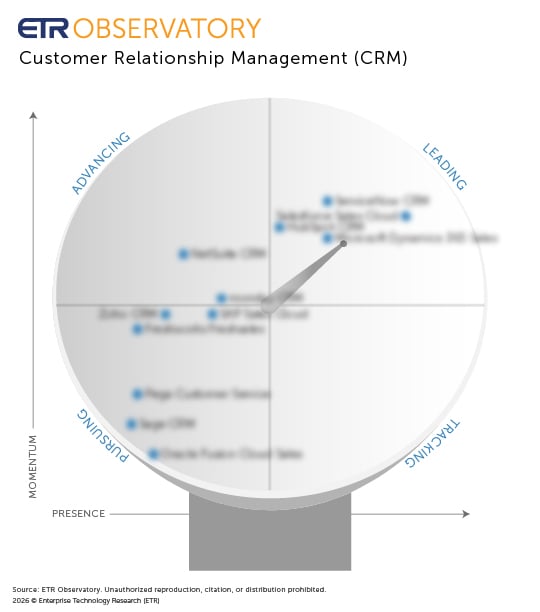
The ETR Observatory for CRM categorizes the vendor group through data-driven plotting across four Observatory Scope vectors using proprietary user and evaluation metrics, including Momentum and Presence. Because the full study asks respondents about both spending intention and evaluation perspectives, a larger array of vendors is covered in the Observatory data; only vendors with sufficient spending intentions citations are included in the Observatory Scope graphic. The Observatory for CRM is based entirely on end-user data and feedback from qualified IT decision-makers, without vendor involvement.
Product Strength Analyses, Expected ROI, and Product Features
Across ten product strength attributes, the vendor leadership rankings remain intact. Microsoft Dynamics posts the highest absolute product-strength scores in the dataset, while Salesforce maintains a decisive lead in buyer preference, rebuild intent, and innovation perception. Microsoft ranks first or tied for first on five of ten attributes, including technical expertise availability (91%), ecosystem integration (84%), update execution (79%), and innovative roadmap (74%). Relative softness in account-representative experience (57%) does not materially offset its positioning as the strongest product in the market.
Salesforce ranks in the top three on seven attributes, including functional completeness (84%) and innovative roadmap (74%), and posts the highest “difficult to replace” score at 68%, the clearest lock-in signal in the dataset. At the same time, it underperforms in ease of implementation (49%) and value for money (52%), reinforcing the view of the platform as essential but increasingly scrutinized economically. The product is also second in integration capabilities at 72%, though 12 percentage points below Dynamics in that measure.
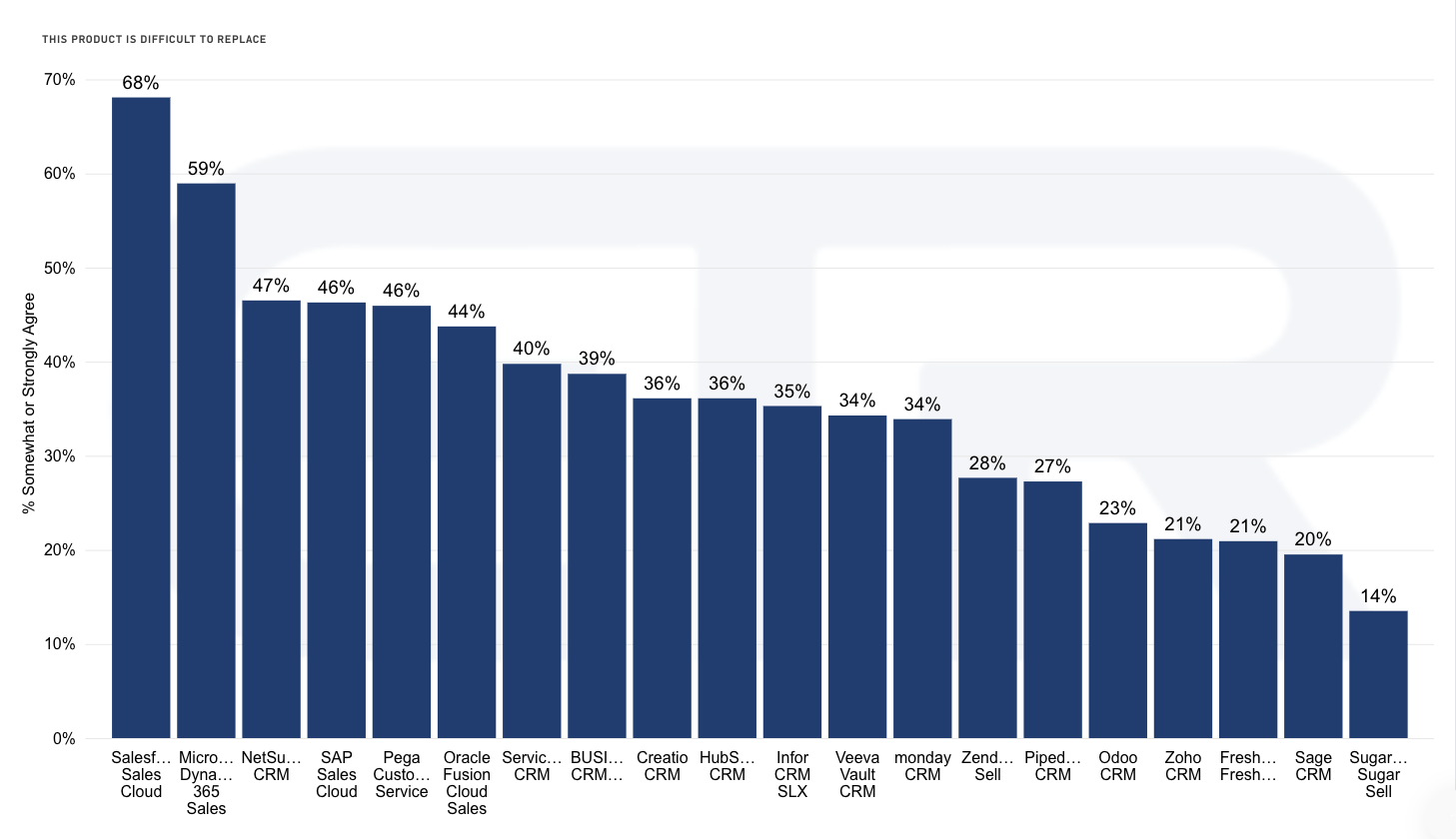 ETR’s Individual Product Strengths analysis was derived from a survey of 306 IT decision makers who have used or evaluated the specific tools listed. Here, vendors are shown by their level of agreement with the statement “This product is difficult to replace.”
ServiceNow sits between the two, ranking in the top three on five attributes, with strengths in technical support (72%), doing everything a CRM should (70%), update execution (69%), and technical expertise (81%). However, its 40% “difficult to replace” score remains a structural gap relative to Salesforce and Microsoft. HubSpot presents a distinct profile, leading in ease of implementation (69%) and value for money (64%), and boasting a strong technical expertise score (74%). These advantages translate into a healthy perception of ROI, but not stickiness. At 36% “difficult to replace,” HubSpot remains the least entrenched of the leaders. Meanwhile, Zoho and Odoo lead on value perception, scoring highly on ease of implementation and value for money without materially sacrificing functional scope.
Closing Remarks
 The CRM market entering 2026 is structurally consolidating around Salesforce, Microsoft, and ServiceNow, with HubSpot as a durable challenger and Zoho as a value-tier disruptor. Legacy enterprise platforms are declining across share, NPS, and longevity, with displacement flowing toward the leader cohort and HubSpot’s adoption funnel. At the same time, the data highlights a divergence in how platforms win. Microsoft leads on product execution, while Salesforce maintains a clear advantage in buyer preference, innovation perception, and long-term entrenchment. HubSpot and Zoho continue to lead on expected ROI, reinforcing a tradeoff between speed-to-value and platform durability. Integration depth, roadmap credibility, and execution consistency define the competitive boundary, while pricing remains a primary constraint on monetizing AI-driven workflows. Vendors that align these elements are positioned to retain their leadership positions; those that do not are already positioned to lose in the next renewal cycle.
|
|
How to Contact Us
Press Need a quote, image, or additional information for an article, reach out to our press team at press@etr.ai
Reprints If you would like permission to reprint this report or our ETR Observatory Scope graphic, please send your request to reprints@etr.ai
ETR Insights Team Contact a member of our ETR Insights team to discuss all the details from this analysis or request custom research.
|
About ETR
ETR is an enterprise technology market research firm that delivers actionable, transparent, and unbiased insights to technology companies, institutional investors, and a trusted community of technology leaders, empowering them to make smarter, faster decisions. ETR’s proprietary approach is grounded in their vision to reinvent technology market research so that business leaders can strategically position their organizations to outperform the competition. In fact, no other firm harnesses the same scale and makeup of their vetted community to quickly deliver the unbiased data and analysis that financial and enterprise organizations need to achieve better outcomes.
We use our two quarterly surveys (Technology Spending Intentions Survey and the Macro Views Survey) to collect data and insights directly from the ETR Community. Use this data and insights to navigate the complex enterprise technology landscape and our proprietary visualizations and models to mine insights and unearth predictors of enterprise technology performance.
Beyond our core surveys, we also offer custom market research surveys. These can be commissioned with a targeted group and are guided by our expert content team to determine the best audience, topics, and questions. Additionally, the target group cannot only be based on their organization size, sector, and title, but also on our proprietary research around a firm’s spending intentions and technology stack.
Methodology
If you’re interested in the process behind the data, you’ll find it in the methodology section on our website.