
Workday Anchors an HCM Market with Sticky Suites and Muted Satisfaction
ETR Observatory for Human Capital Management (HCM)
This is a summary of the full report. ETR clients receive the complete findings; use the form at the bottom to request access to the complete findings.


Key Takeaways
- Workday is the structural center of HCM. Workday is the most pervasive vendor by a wide margin, with 41% usage among survey respondents, roughly double the next vendor. It also leads rebuild intention and innovation perception, at multiples over peers, and holds the only non-negative Net Promoter Score.
- Enterprise suites lead spending momentum. Oracle Fusion (60% Net Score) and SAP SuccessFactors (59%) edge Workday (47%), but on far smaller installed bases (N=40 and N=70 vs. N=124). Spending intent is rising fastest for Oracle and SAP, but Workday remains by far the most widely used tool.
- Lock-in is concentrated in the enterprise suites. Oracle (60%), SAP (59%), and Workday (57%) are the only vendors above 50% on “difficult to replace,” and they also show the longest expected use, with 76% of SAP users, 72% of Oracle users, and 69% of Workday users expecting three-plus more years. Payroll- and SMB-oriented tools are less entrenched, led by Paycor, BambooHR, and Rippling at the low end.
- Speed-to-value and stickiness move in opposite directions. Payroll and SMB platforms deliver the fastest expected payback, led by Paycor (76%), Paylocity (73%), and ADP (68–69%). Oracle sits at the other end, with just 42% expecting ROI within three years and 51% expecting payback only after year three, reflecting the broader HCM trade-off between faster ROI and deeper enterprise durability.
- Advocacy is a structural weak spot, while AI remains secondary. NPS is negative for all tracked vendors but Workday. Buyers prioritize integration, ease of use, and payroll capabilities over AI integration, with roadmap innovation and technical support as key recommendation drivers.
Introduction
Human Capital Management (HCM) has evolved from siloed payroll and record-keeping systems into the operational system of record for the workforce. Modern platforms unify core HR, payroll, benefits, time and attendance, talent, and learning into a single data layer, the foundation on which workforce analytics and, increasingly, AI-driven automation will run. The category splits into two structurally different cohorts: broad enterprise suites that win on breadth, global compliance, and entrenchment, and payroll-led or SMB-oriented platforms that win on deployment speed, usability, and price.
A central tension this cycle is that HCM platforms are more embedded than endorsed. Buyers depend on these systems to run the workforce, but that reliance is not translating into strong advocacy. A small number of suites anchor the enterprise, yet even high momentum vendors carry their share of detractors. Layered on top is embedded AI. Vendors are racing to add agentic automation to recruiting, workforce planning, and employee self-service, while buyers still rank AI well below integration, ease of use, and payroll management. In this first Observatory for HCM, ETR examines how these forces translate into spending, usage, retention, advocacy, and product perception across seventeen vendors.
The Observatory Report
 The Observatory Report. This Observatory features comprehensive and current data about Human Capital Management (HCM) tools and marketplace dynamics. The ETR Observatory for HCM was designed to capture usage and evaluation metrics across a wide swath of professionals representing the end-user and evaluator buying demographic. The study offers data and analysis on spending trends, usage, return on investment (ROI), churn, product feature rankings, Net Promoter Scores (NPS), and more. This report utilizes only a portion of that market intelligence data; the full HCM study is available separately.
The ETR Observatory for HCM categorizes the vendor group through data-driven plotting across four Observatory Scope vectors using proprietary user and evaluation metrics, including Momentum and Presence. The 9 vendors meeting an N≥15 spending-intentions citation threshold are charted in the Net Score and longevity analyses. Product-perception and ROI questions include evaluators and therefore carry broader samples, so additional vendors appear in those analyses. The Observatory for HCM is based entirely on end-user data and feedback from qualified IT decision makers, without vendor involvement.
Respondent Composition. ETR's 2026 Observatory for HCM polled 305 IT decision makers, including 59 from Fortune 500 organizations and 87 from Global 2000 organizations. The base skews Large (62%) with 21% Midsize and 18% Small respondents. Industry representation is led by Services/Consulting (22%), IT/TelCo (17%), and Financials/Insurance (14%). The respondent base is 76% at the VP/Director level or above (25% CxO). Geographically, the sample is concentrated in North America (72%), followed by EMEA (17%) and APAC (10%). All participants are vetted members of the ETR Community, screened for relevant experience and vendor expertise.
Product Strengths, Expected ROI, and Product Features
Across ten product-strength attributes, Workday and SAP post the highest absolute readings in the dataset, tying for the single strongest score on availability of technical expertise (82% each). Workday ranks first or tied-first on roughly half the attributes, including "does everything I expect an HCM tool to do" (77%), technical support (73%), ecosystem integration (73%), and well-executed updates (71%); SAP closely mirrors that profile, leading on integration (73%). Two of those leads, technical support and ecosystem integration, rank among attributes that most move recommendation in ETR's drivers analysis below, meaning the suites are strongest where advocacy is more likely to be decided. Oracle Fusion scores higher on vendor-relationship attributes, holding the survey's highest "account representatives" score (67%) alongside 70% on both technical support and integration.
Two challengers post category-leading single attributes despite smaller bases. Rippling holds the highest score for an "innovative technical roadmap" (82%, N=38), and HiBob leads "easy to implement" (81%, N=31), distinct profiles that reflect modern, fast-deploying platforms.
Replacement difficulty, a proxy for stickiness, splits cleanly along the enterprise/payroll divide. Oracle (60%), SAP (59%), and Workday (57%) are the only vendors above 50%, while payroll and SMB-oriented platforms cluster well below. Paycor is the least entrenched at 22%, with BambooHR (30%), Rippling (32%), HiBob (32%), and Paycom (32%) close behind. This is the clearest structural moat in the category. The enterprise suites are not just larger; they are far harder to replace once in place. That edge also grows with account size. SAP's "difficult to replace" score is 68% among large enterprises but just 36% in the midsize/small cohort (N=25), while Oracle holds a uniform 60% across both size cohorts.
Expected ROI inverts that hierarchy. Payroll and SMB platforms dominate speed-to-value. Paycor leads with 76% of users expecting payback within three years, followed by Paylocity (73%), ADP Lyric (69%), and ADP Workforce Now (68%). Oracle Fusion sits at the bottom at 42%, with a survey-high 51% expecting payback only after three years, a reflection of the heavier implementation and services burden of large enterprise deployments. The pattern frames the central buyer trade-off in HCM with faster, lower-friction payback from payroll-led tools versus slower but far stickier value from the enterprise suites.
Asked what matters most in an HCM tool, respondents led by citing system integration (35%), ease of use (31%), and payroll management (25%) dominate the coded write-ins, with AI integration a secondary but emerging priority at 11%.
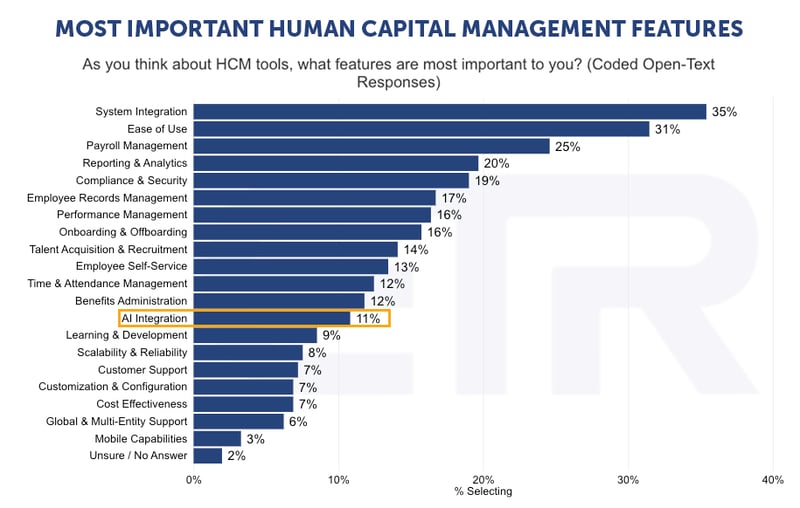
Figure 1. The features respondents say matter most in an HCM tool, grouped by coded write-in responses. Fundamentals like integration, ease of use, and payroll lead the list, while AI lands further down as an emerging rather than a deciding priority.
ETR's drivers of recommendation analysis reorders those stated priorities. An innovative technical roadmap carries the highest derived impact on likelihood to recommend, followed by technical support, ecosystem integration, and difficulty of replacement, the four leading drivers. What buyers say they want (usability, payroll) and what actually moves advocacy (roadmap, support, integration) are not the same list. That roadmap-led result lands amid an industry-wide sprint to embed agentic AI into HCM. Workday's Illuminate agents and SAP SuccessFactors' Joule agents are visible examples. Buyers appear to reward a believable AI trajectory inside an already-unified platform over any standalone AI capability.
Figure 2. The table above displays selected commentary from write-ins on what matters most in an HCM tool. A unified, one-stop platform is the most consistent thread across the responses, followed by intuitive usability, reporting and analytics, and depth in payroll and compliance, with AI surfacing only as a supporting capability.
Closing Remarks
The HCM market entering mid-2026 is anchored by Workday, with SAP SuccessFactors and Oracle Fusion forming a high-momentum enterprise challenger tier. Around them sits a long tail of payroll-led and SMB-oriented platforms differentiating on speed and price. Two themes stand out. First, buyers depend on these platforms more than they would recommend them. Workday is the most used, most desired, and most credited with innovation, yet it only breaks even on advocacy, while nearly every other vendor counts more detractors than promoters. Second, staying power and speed trade off. The enterprise suites are hard to replace and hold users longest but pay back slowly, while payroll/SMB tools pay back fast and churn more readily.
HCM recommendations are driven most by roadmap credibility, integration depth, and dependable support, and those are exactly the enterprise suites' strengths. The next renewal cycle favors incumbents that add a better usability and advocacy story to that durability, and challengers that turn fast payback and modern UX into genuine staying power. AI is reinforcing the incumbents for now, but its value will be realized through the unified data and workflow layer buyers already prize, not as a standalone feature.
|
|
How to Contact Us
Press Need a quote, image, or additional information for an article, reach out to our press team at press@etr.ai
Reprints If you would like permission to reprint this report or our ETR Observatory Scope graphic, please send your request to reprints@etr.ai
ETR Insights Team Contact a member of our ETR Insights team to discuss all the details from this analysis or request custom research.
|
About ETR
ETR is an enterprise technology market research firm that delivers actionable, transparent, and unbiased insights to technology companies, institutional investors, and a trusted community of technology leaders, empowering them to make smarter, faster decisions. ETR’s proprietary approach is grounded in their vision to reinvent technology market research so that business leaders can strategically position their organizations to outperform the competition. In fact, no other firm harnesses the same scale and makeup of their vetted community to quickly deliver the unbiased data and analysis that financial and enterprise organizations need to achieve better outcomes.
We use our two quarterly surveys (Technology Spending Intentions Survey and the Macro Views Survey) to collect data and insights directly from the ETR Community. Use this data and insights to navigate the complex enterprise technology landscape and our proprietary visualizations and models to mine insights and unearth predictors of enterprise technology performance.
Beyond our core surveys, we also offer custom market research surveys. These can be commissioned with a targeted group and are guided by our expert content team to determine the best audience, topics, and questions. Additionally, the target group cannot only be based on their organization size, sector, and title, but also on our proprietary research around a firm’s spending intentions and technology stack.
Methodology
If you’re interested in the process behind the data, you’ll find it in the methodology section on our website.