

Navigating the Crowded Observability Landscape

ETR Observatory for Observability Tools
This is a summary of the full report. Use the request form at the bottom of the article to download the complete findings.


Today’s observability tools monitor a wide array of systems and data sources, including logs, traces, and metrics across networks, infrastructure, applications, AI models, data management systems, IoT devices, mobile devices, and more. Modern tools aim to balance extensive coverage across intricate, multifaceted tech stacks with user-friendly interfaces, data visualizations, dashboards, and refined administrative controls. AI is rapidly transforming the observability space, providing more nuanced insights that penetrate the flood of information and have the capability to act autonomously to address problems before they escalate. And AI applications themselves are in need of observability tools, with every major vendor in this market boasting automated, agentic features.
Organizations are embracing open standards for observability as well, particularly OpenTelemetry, as companies resist vendor lock-in and the associated risks of proprietary data formats. OpenTelemetry is a collection of APIs and SDKs for managing observability data and metrics. Adding to the complexity of the market are open-source tools and vendors with freemium subscription models, such as Prometheus, Grafana, and Elastic. The rise of the OpenTelemetry standard and prominence of open-source/freemium tools in tech stacks adds complexity to a multi-tool architectural reality facing most organizations.
This Observatory features comprehensive and current data about the observability marketplace. The ETR Observatory data for Observability Tools was specifically designed to capture usage and evaluation metrics across a wide swath of professionals representing the end user and evaluator buying demographic. While structuring a group of disparate vendors with varying functionalities is subjective, the ETR Observatory for Observability Tools categorizes the vendor group primarily by breaking down the data-driven plotting of each vendor into our four Observatory Scope vectors and by analyzing proprietary user and evaluation metrics, including Momentum and Presence.
Microsoft Azure Monitor a Stand-Out in Spending and Stickiness
 The 2026 ETR Observatory for Observability Tools surveyed 301 IT decision makers. Most (59%) represent Large enterprises of more than 1,200 employees, with 51 at Fortune 500 firms and a quarter (25%) at Global 2000 enterprises. The three most representative industry verticals are Services/Consulting, IT/TelCo, and Financials/Insurance, collectively comprising more than half (58%) of the sample. Nearly three-quarters (72%) of respondents are in North America and 17% are in EMEA, with the remainder representing APAC (8%) and Latin American (2%) regions. Half (50%) of respondents hold VP or Director-level titles, and the remainder are split between C-level roles (25%) and practitioner roles (25%).
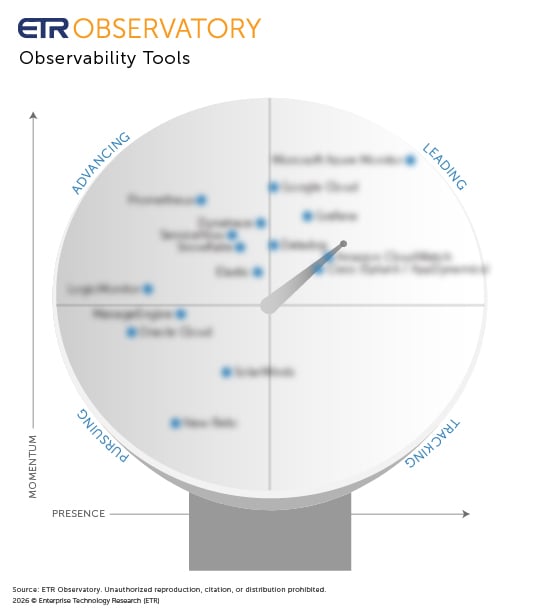
The report categorizes vendors across different categories, reflecting their Momentum and Presence within the Observability space:
-
Leaders like Microsoft Azure Monitor, Google Cloud Observability, Grafana, and Datadog show strong adoption and market share, driven by broad capabilities and ease of use.
-
Advancing vendors like Prometheus, Dynatrace, ServiceNow Observability, Elastic, and Snowflake are gaining Momentum but still lag in Presence compared to market leaders.
-
Pursuing vendors, including ManageEngine, Oracle Cloud Observability, SolarWinds Observability, and New Relic, are experiencing slower growth, with less impact in the market.
Microsoft Azure Monitor leads the observability market in spending plans, with a Net Score of 48%. Google Cloud Observability (46%) and Prometheus (45%) follow behind. Net Scores are a snapshot of positive spending plans (Adoption and Increase indications) minus negative spending plans (Replacement and Decrease indications). These vendors with the highest spending Momentum have minimal Replacement indications (all at 1% or lower) and low Decrease spending plans. Dynatrace (42%), Grafana (42%), ServiceNow Observability (41%), Snowflake (40%), and Datadog (39%) comprise the next tranche of vendors by Net Score, with Datadog showing the most elevated Replacement plans in this group at 6%. SolarWinds Observability (17%) and New Relic (3%) have the lowest Net Scores.
Compared to last year’s Observatory, only three vendors saw their Net Scores increase: Dynatrace, up 3.5 percentage points (ppts); ServiceNow Observability, up 3.0 ppts; and Cisco, up 1.8 ppts. (Note: in the 2025 survey Splunk and AppDynamics were tracked as separate products, whereas in 2026 they are combined under the Cisco banner; year-over-year comparison for Cisco, then, is derived from a citation-weighted average of the two products’ Net Scores from 2025). Most vendors in the study saw Net Score decreases year-over-year, with Oracle Cloud Observability (down 25.6 ppts), Amazon CloudWatch (down 22.5 ppts), and Microsoft Azure Monitor (down 8.9 ppts) declining the most.

Cloud Providers, Datadog, and Dynatrace Lead in Several Vendor Strength Categories
A Net Promoter Score (NPS) for the vendors in this study simply rates which vendors respondents would recommend to their colleagues, following industry-standard measures of “promoters” (a 9 or 10 likelihood to recommend) minus “detractors” (a 6 or lower likelihood to recommend). The three major cloud platforms, along with long-time observability giants, lead in NPS. Microsoft Azure Monitor, Google Cloud Observability, Amazon CloudWatch have the top three NPS ratings, followed by Cisco, Datadog, and Dynatrace. Sumo Logic, Honeycomb, and LogicMonitor have the lowest NPS ratings.
Respondents were asked to provide write-in responses stating the vendors they saw as the most desired among observability tools and the most innovative. For most desired, this meant a vendor that a respondent would choose to prioritize if given the opportunity to completely rebuild their organization’s observability stack. Microsoft, Datadog, and Dynatrace, and Cisco’s offerings led most desired in rank order. Among many attributes, what makes a product desired is a tool’s completeness or ability to do what is expected of it, as well as its ability to integrate with an organization’s existing technical ecosystem. Interestingly, it is Google Cloud Observability that leads among individual vendors strengths for doing everything expected of an observability tool, followed by Dynatrace and then Microsoft Azure Monitor. For ease of integration, the top vendors are Microsoft Azure Monitor, Cisco, and Amazon CloudWatch.
In the write-in question for who respondents view as the most innovative observability tool, Datadog, Microsoft, and Dynatrace top the list. As a corollary to the innovation rankings, however, Google Cloud Observability, yet again, has the highest rate of agreement to the statement, “this product has an innovative technical roadmap.” Dynatrace, Datadog, and Microsoft Azure Monitor follow behind in rank order for innovative roadmap. For other individual vendor strengths, Google ranks highest for well-executed updates and Dynatrace is tops for best technical support and enjoyment of working with account representatives.
Conclusion – Room for Many Thriving Vendors in a Multi-Observability-Tool Reality

Observability is rapidly evolving as AI, data growth, and shifting market demands blur traditional boundaries. AI is pushing the space from reactive monitoring to proactive operations, enabling faster issue resolution through automation and intelligent insights. At the same time, expanding data sources and rising security and regulatory pressures are increasing complexity and pushing vendors into new domains. Open standards and maturing open-source tools are also reshaping expectations, forcing vendors to prioritize flexibility and reduce lock-in.
This momentum has created a highly competitive, fragmented market. Cloud providers like AWS, Microsoft, and Google remain strong, while players like Datadog, Grafana, and Cisco continue to innovate. Meanwhile, open-source and enterprise platforms alike are competing across performance, usability, and ROI. Most organizations still rely on a mix of tools, but tightening budgets may drive consolidation. In response, vendors are racing to stand out with smarter features, better user experiences, and broader platform capabilities.
|
|
How to Contact Us
Press Need a quote, image, or additional information for an article, reach out to our press team at press@etr.ai
Reprints If you would like permission to reprint this report or our ETR Observatory Scope graphic, please send your request to reprints@etr.ai
ETR Insights Team Contact a member of our ETR Insights team to discuss all the details from this analysis or request custom research.
|
About ETR
ETR is an enterprise technology market research firm that delivers actionable, transparent, and unbiased insights to technology companies, institutional investors, and a trusted community of technology leaders, empowering them to make smarter, faster decisions. ETR’s proprietary approach is grounded in their vision to reinvent technology market research so that business leaders can strategically position their organizations to outperform the competition. In fact, no other firm harnesses the same scale and makeup of their vetted community to quickly deliver the unbiased data and analysis that financial and enterprise organizations need to achieve better outcomes.
We use our two quarterly surveys (Technology Spending Intentions Survey and the Macro Views Survey) to collect data and insights directly from the ETR Community. Use this data and insights to navigate the complex enterprise technology landscape and our proprietary visualizations and models to mine insights and unearth predictors of enterprise technology performance.
Beyond our core surveys, we also offer custom market research surveys. These can be commissioned with a targeted group and are guided by our expert content team to determine the best audience, topics, and questions. Additionally, the target group cannot only be based on their organization size, sector, and title, but also on our proprietary research around a firm’s spending intentions and technology stack.
Methodology
If you’re interested in the process behind the data, you’ll find it in the methodology section on our website.