

UCaaS Buyers Want Functionality Over Flashy Features

The 2025 ETR Observatory for UCaaS study collected data on the following products:
8x8 X Series | Alcatel-Lucent Enterprise | Amazon Chime | Avaya Cloud Office | Cisco Webex | Dialpad Ai Voice | Evolve IP Unified Communications | Google Voice (Workspace) | GoTo Connect | Intermedia | Microsoft Teams | Nextiva | RingCentral | Sangoma Switchvox Cloud | Vonage Business Communications | Wildix | Zoom Workplace
No longer simply used for offloading phone systems to the cloud, Unified Communications as a Service (UCaaS) has evolved towards a broader category of platform SaaS, offering end-to-end collaboration that encompasses chat, video conferencing, asynchronous workflows, and productivity suite integration. By now, UCaaS operations have largely matured (in part fueled by the COVID-19 pandemic), and now many organizations find themselves in a “steady state,” with legacy transitions in the rearview. Modern UCaaS is about providing seamless connectivity, no matter where you are, enhancing digital workflows, supporting hybrid work, and embedding AI-driven automation across the meeting and communications lifecycles.
Budgets are still expanding, albeit modestly, with investments concentrated around incremental seat growth and AI experimentation. Large-scale forklift upgrades have slowed, replaced by more surgical, ROI-focused enhancements to mature stacks. Today, buyers are operating in an enterprise IT landscape shaped by constrained growth expectations, rising vendor pricing, and increasing regulatory and geopolitical complexity. UCaaS platforms are being evaluated not just on features but on their ability to consolidate tools, integrate with existing systems, and deliver measurable business value. As organizations face tighter budget oversight and more deliberate procurement cycles, multi-vendor environments – often born of necessity – are under pressure. Rationalizing spending, aligning with broader ecosystems, and accelerating time-to-value have become central goals.
The appetite for innovation remains high, but it's grounded in pragmatism. AI enhancements increasingly make their way into UCaaS platforms, but most deployments are still early-stage, focused on pilots or select business units. These features are starting to stretch the traditional definition of UCaaS, bleeding into adjacent areas like task management and process automation. However, many IT leaders, particularly those within regulated sectors, still emphasize the need for human oversight and governance. Ultimately, UCaaS success in 2025 and beyond will depend not on the flashiest features, but on a platform’s ability to integrate seamlessly, support existing workflows, and deliver tangible improvements without unnecessary complexity.
Breadth, Cost Efficacy, and Reliability Drive UCaaS Purchases
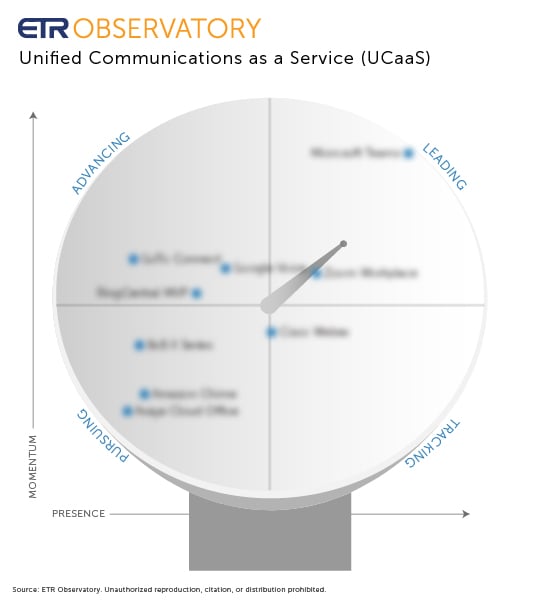 Enterprise Platform Gravity. Enterprise tech giants Microsoft and Google continue to dominate mindshare with their Teams and Voice offerings—tightly integrated with Microsoft 365 and Google Workspace and backed by their expansive ecosystems. Teams defines the UCaaS standard. Microsoft continues to benefit from its platform bundling strategy, as one CIO/CISO for a large IT business services enterprise put it: “You just get so many things with an E5 license, it’s like, how can I not pass this up?” Earlier described as “adequate” or “good enough,” Teams’ perception–and functionality–has improved over time as Microsoft steadily adds features and reinforces the value of its bundle.
Though Google is less dominant than Microsoft or AWS in the broader enterprise technology world, it is well-regarded in productivity and collaboration, especially among SMBs and in education or government. Within those ecosystems, Voice is a natural extension of Workspace.
Cisco retains trust in regulated environments, especially among existing networking and information security customers, but newer features have yet to shift perceptions. Zoom, meanwhile, continues to be appreciated for its simplicity, though sometimes struggles to shake the reputation of being only a video-first solution. Zoom’s expanding feature sets mark a foray into broader productivity, collaboration, and workflow automation.
Function Over Flashiness. UCaaS innovation is now measured more by ecosystem depth than isolated features; users are not looking for bells and whistles – they are looking for fewer tabs, fewer apps, and smarter workflows. Teams leads on perceived innovation (43%), well ahead of Zoom (21%), with Cisco (7%), Google (6%), and RingCentral (4%) further behind. Vendor rebuild scenarios align: 53% would choose Teams again if starting fresh.
Teams’ integration and maturity are often praised, though limitations persist. One CTO noted how “Teams just wasn’t even close” for needed contact center functions, which drove the organization to purchase RingCentral as a point solution, while keeping Teams internally. Other users noted post-pandemic consolidation: “You sort of threw licenses out [back then].” In the ensuing time, peppered with macroeconomic unpredictability, this leniency in spending has eased. Now, growth is incremental, with fewer feature requests and a push toward optimization over reinvention.
Explaining the rationale for a Teams consolidation, one IT services CIO opined: “Is it as good as Zoom? No, but is it adequate? Yeah, it’s good enough.” Another mentioned how finance questions “paying twice” with Teams in the environment: “I can see a possible shift from Zoom to Microsoft Teams.” Though, he considered that “Zoom has very good integration with Slack, so it's almost the same thing,” which highlights the commodification and broad interchangeability of UCaaS functions.
Still, there are benefits to going “all in on Teams,” as one CTO described: “We're all over the planet, so if the old PBX had a problem, there were certain subject matter experts you had to get, and they had to be in their time zone to be able to help. Nowadays, we have distributed skillsets around Teams as well. So, we're better able to manage any issues that do [surface]. Frankly, there have not been too many; [Teams] has certainly been quite stable.”
The smooth veneers of easy-to-use SaaS platforms oversimplify the technology infrastructure and integrations at play. Even with this push towards consolidation, many organizations still operate multi-vendor environments due to regional limitations, backup needs, physical infrastructure requirements, and coverage gaps. Regulated sectors like healthcare, finance, and government lean toward Microsoft or Cisco for compliance and security. Cost-sensitive buyers, especially in the mid-market, may still turn to RingCentral or 8x8 – but increasingly, Microsoft or Google platform bundles offer stronger cost efficacy.
Per-user licensing remains dominant – used by 83% and preferred by 68% – with predictable budgeting cited as the main draw. Alternative models like site-based or per-device licenses retain niche appeal (21% preference), Usage-based pricing, once championed by Amazon Chime (now retired), was experienced by 19% but preferred by only 5%.
ROI expectations vary: 79% of Microsoft users report seeing returns within the first three years (49% within 12 months). Zoom follows closely (69% within three years, 43% within one). Cisco, Google, and RingCentral also see a majority citing ROI within three years. Meanwhile, vendors like 8x8, GoTo, and Avaya reflect slower or more uncertain returns.
The Next Frontier
Closing Remarks
The interplay between the metrics in the 2025 Observatory for UCaaS report paint a clear picture: Teams dominates through deep integration and long-term adoption; Zoom remains strong but contends with cost and usage overlap; and mid-tier platforms like RingCentral, Google Voice, and GoTo Connect carve out stable niches. Microsoft and Zoom firmly anchor the Leading vector, buoyed by brand strength, productivity suite integration, and consistent user satisfaction. Teams continues to deepen its footprint through the Microsoft ecosystem while Zoom remains a fan favorite but struggles to compete with Microsoft’s breadth.
Mid-tier vendors like Google Voice, GoTo, and RingCentral sustain steady year-over-year growth by meeting cost-conscious needs and integration gaps. Google holds particular appeal among SMBs, while Cisco remains entrenched despite a weaker data set. Meanwhile, Amazon Chime’s retirement confirms its exit, and 8x8 and Avaya remain niche, with limited Momentum.
At a broader level, the UCaaS market continues its gradual shift towards intelligent collaboration ecosystems, increasingly infused with AI. The big roll outs are done and have been for years now in many cases. The technology is mature. Future investments are expected to support incremental enhancements rather than spark wholesale transformation.
Innovation appetite remains strong, but pragmatism prevails. AI features are beginning to reshape UCaaS platforms, with some enterprises expanding deployments as others are just testing the waters. These developments are pushing the boundaries of UCaaS into broader collaboration and automation territories, though these technologies are still in the early stages, still requiring human-in-the-loop governance. The platforms most likely to succeed going forward will be those that integrate cleanly, enhance workflow efficiency, and deliver value without unnecessary complexity.